Showing posts with label religion. Show all posts

Sunday, May 18, 2025

Vital Viewing (Preach Therapy Edition)


Not to be confused with a one-time cast member on Law and Order, screenwriter and director Richard Brooks was born on this date in 1912 (he died in 1992.) Among several well-known movies that Brooks wrote and directed were Blackboard Jungle (1955), Cat on a Hot Tin Roof (1958), In Cold Blood (1967) and Looking for Mr. Goodbar (1977), all worthwhile films, but the one I want you to recommend to you today is this 1960 adaptation of a best-selling novel of the Wild (Mid)West: 


Academy Award voters of the day seem to second my recommendation. But first a word from Bob:


I like Kitty's gown, but that's neither here nor there. What IS here or there is the trailer for the movie, a movie that also won Oscars for leading man Burt and the future Mrs. Partridge:


Elmer didn't get to become Pope either.

Tuesday, April 22, 2025

Matthew 7:1 Pride


1936-2025


Who am I to judge?

--Pope Francis, 2013

 In a televised interview, where we spoke with natural and conversational language, it is understandable that there would not be such precise definitions...It is not the first time that I speak of homosexuality and of homosexual persons. And I wanted to clarify that it is not a crime, in order to stress that criminalization is neither good nor just...When I said it is a sin, I was simply referring to Catholic moral teaching, which says that every sexual act outside of marriage is a sin. Of course, one must also consider the circumstances, which may decrease or eliminate fault...As you can see, I was repeating something in general. I should have said, "It is a sin, as is any sexual act outside of marriage,"...This is to speak of  "the matter" of sin, but we know well that Catholic morality not only takes into consideration the matter, but also evaluates freedom and intention; and this, for every kind of sin...And I would tell whoever wants to criminalize homosexuality that they are wrong.

--Pope Francis, 2023

In the past I've thought about making Francis the subject of one of these "Pride" posts that I periodically do whenever a public figure says something positive about the LGBTQ community, especially if that public figure is themself not known to be LGBTQ (after all, they have less incentive to say something positive.) Instead, I held back. For one thing, this blog is not particularly tailored to the sensibilities of Roman Catholics. Don't like your church's (pre-Francis) stand on homosexuality? Then go find some other church! Also, I thought there was quite a bit of equivocating in that 2023 quote. I wanted something more forthright. And he says nothing about gay marriage, the lack of which dooms a gay sin-averse devout Catholic to a lifetime of...celibacy (hmm, let's not go there.)

As you can see, I've changed my mind. What changed that mind? Well, I thought, there are a lot of Roman Catholics in the world. Having lived all my life so far in the Cleveland area, I've certainly met my fair share of them (starting with my parents, who practiced a lapsed version of the faith.) Then there's this:


That picture was taken just yesterday outside the Papal Basilica of Saint Mary Major, where the late pope will be laid to rest. As I understand it, that flag is not being waved in protest but in support of Francis and his stand on LGBTQ matters. It's a reminder to me that some people can't change their belief systems as easily as I can change what toppings I put on my burger. One small step for a gay secularist or gay humanist is one giant leap for any gay person who would just as soon accept their church's teaching, especially when their church's teaching accepts them. Who am I to judge?

Thursday, March 6, 2025

Smart Art (In Over Your Head Edition)


Wednesday, March 27, 2024

Quips and Quotations (Imagine There's No Heaven Edition)


He had, in fact, got everything from the church and Sunday School, except, perhaps, any longing whatever for decency and kindness and reason.

--Sinclair Lewis, Elmer Gantry

Sunday, February 4, 2024

Graphic Grandeur (Spiraling Spirituality Edition)


Clay Bennett on the possible perils of mixing religion and politics.

Friday, October 13, 2023

The Smartest Religious Movie Ever Made

 (Recent events in the region of the world commonly referred to as the "Holy Land" has compelled me to rerun this post from 6/21/2010. I've added pictures--Kirk)


Recently, I wrote a post about faith which seemed to stir up a lot of strong feelings. So strong were these feelings, in fact, that I decided it best to stay away from the subject from now on. But then I saw my name mentioned on someone else's blog dealing with faith, and thought, "Well, if people are still interested in my views on the subject..." So I've decided to take another stab at it. I've even eschewed the usual wordplay in the post's title. I'm telling you flat out it's about the smartest religious movie ever made.


And what movie might that be? The Ten Commandments? No, as entertaining as that film is, it's not the smartest. Nor is it that other mainstay from Easters past, Ben-Hur.


And it's not King of Kings, Sign of the Cross, Song of Bernadette, Going My Way, Bells of St. Mary, The Keys of the Kingdom, Joan of Arc, Samson and Delilah, David and Bathsheba, Quo Vadis, The Robe, Demetrius and the Gladiators, Miracle of Our Lady of Fatima, Salome, Solomon and Sheba, The Silver Chalice, The Big Fisherman, Barabbas, Sodom and Gomorrah, The Nun Story, The Singing Nun, Lillies of the Field, The Agony and the Ecstasy, The Greatest Story Ever Told, The Bible...In The Beginning, The Sound of Music, Godspell, Jesus Christ Superstar, King David, or The Last Temptation of Christ.


It's not even Bruce Almighty

No, the smartest religious movie ever made is...


...Raiders of the Lost Ark!

What's that, you say? Raiders of the Lost Ark? That's not a religious movie! It's action-adventure!

Well, there is action, as well as adventure. And there's also religion. At least there's something from the Bible. Where do you think the Ark comes from? Actually, there are two Arks in the Bible. The more famous Ark is the big boat with all the animals that Noah captained. The other Ark, the Ark of the Covenant, is less well known. At least it was less well known before director Steven Spielberg, producer George Lucas, and screenwriter Lawrence Kasdan got their hands on it. Here's King James' earlier take:


10 "And they shall make an ark of acacia wood; two and a half cubits shall be its length, a cubit and a half its width, and a cubit and a half its height. 11 And you shall overlay it with pure gold, inside and out you shall overlay it, and shall make on it a molding of gold all around. 12 You shall cast four rings of gold for it, and put them in its four corners; two rings shall be on one side, and two rings on the other side. 13 And you shall make poles of acacia wood, and overlay them with gold. 14 You shall put the poles into the rings on the sides of the ark, that the ark may be carried by them. 15 The poles shall be in the rings of the ark; they shall not be taken from it. 16 And you shall put into the ark the Testimony which I will give you.

--Exodus 25:10-16

The above is God's instructions to Moses on how to build the Ark. Where Moses was supposed to get all that gold, I have no idea. Anyway, the Ark was a kind of chest with supernatural powers that contained bits and pieces of the original Ten Commandments. The Israelites carried it around the wilderness for some 40-odd years, until they reached the Promised Land. After that, it pops up throughout the Old Testament, often to lethal effect, zapping Philistines or even dim-witted Israelites who come too near the thing. Keep that in mind as I discuss the movie.


Now, I said Raiders was smart. But it's not immediately smart. Like any Hollywood product designed to separate an adolescent from his 1981 currency, there's a lot of watchable silliness. The movie begins in a South American jungle in 1936, where we find a big guy with a big hat, ratty clothes, and a whip going into a cave to snatch an ancient idol, evading all sorts of pre-Industrial Age booby traps to do so. He gets out of the cave alive, only to be confronted by an apparent archrival backed by a bunch of spear carrying natives. Our hero is forced to hand over the idol, and then somehow manages to outrun, outjump, and and outswing hundreds of spears thrown in his direction. None of this has anything to do with the Ark of the Covenant, which is in a whole different hemisphere. It's all meant to establish character, and, boy, what a character: Indiana Jones, an professor of archeology (his real first name is Henry, but you won't find that out for another couple of sequels) who apparently doesn't believe in hiring hundreds of diggers to excavate a site, but rather just do the job himself.


Back in his classroom at the university, having exchanged his ratty clothes and whip for a tweedy suit and blackboard chalk, he's approached by a couple of government agents. Adolf Hitler is looking for the Ark of the Lost Covenant, hoping its' powers of God will give him an edge in the upcoming World War II. Now, the agents refer to Hitler as a "nut" and that he's "crazy" for actually thinking he can get away with this. But as nutty and crazy as Hitler may be, they decide to hire Professor Jones to stop him, just to be on the safe side. Do intelligence agents always outsource their work to college archeology professors? They must be understaffed.


Anyway, Indiana Jones goes to Cairo, meets an old flame who decides to help him find the Ark. The Nazis, along with the archrival from the film's opening scene, try to stop him. But Indy does indeed find the Ark, only to quickly lose it to the Nazis. My memory's a bit faulty on this, but the Ark seems to pass back and forth between the Jones and the Nazis until they all end up on some island together. Indy has a chance to destroy the Ark with a rocket launcher (good thing to have when a whip won't do), but, dedicated archaeologist that he is, can't bear to destroy something of such obvious historical significance.

Now we come to the part that always intrigues me. The Nazis have won. They've prevailed. They've got the Ark. Before presenting it to the Fuhrer himself, they decide to take a peek inside.


They shouldn't have. Benign ghostlike figures at first emerge, but they quickly turn malignant. Fire and lightening shoot out out of the Ark, fricasseeing the Nazis standing closest to it. The ones standing a little farther away don't last much longer, as they soon melt or combust or both. Only Indy and his girlfriend survive, having shielded their eyes.

So by winning the Nazis have lost. The power of God gives them no actual military advantage. How you gonna use a weapon if you can't even open the damn thing? Not that the U.S. government is much better. They must have shelled out a lot taxpayers' money, in transportation costs if nothing else, to have Indiana Jones go halfway around the world to stop the Nazis from finding something that turned out to be irrelevant. He could have saved himself the trouble and just stayed in the classroom, though it's always nice to see old lovers reunite.


Indy gets the Ark (did he close it back up with his eyes shut?) to Washington D.C., where it is stored in a giant government warehouse.

"Fools. Bureaucratic fools! They don't know what they've got there," Indy says at the end.


I imagine sometimes after Pearl Harbor, some of those bureaucratic fools will open up the Ark to see just what kind of military advantage it gives them. When they do, well, time to mop up the warehouse floor. So the WWII in the movie's fictional world is fought much like the WWII in our real one, without any discernible help from God.


Of course, in our real world, people are always fighting and thinking God gives them some sort of advantage. Look at the Middle East. The Israelis and the Arabs have been fighting over the Holy Land for how long now? And why is it even called the Holy Land? If the Lord created the entire Earth, shouldn't the whole enchilada be considered holy, rather than just one tiny morsel? Then there's the people who attacked us on 9/11, thinking they were doing God's work. The average devout terrorist doesn't even have to open up an ark if they wish to immolate themselves. They'll do it with a strapped-on bomb, with the expectation that they'll be greeted in Heaven by 72 virgins (what do they have against more experienced women?) And what about female suicide bombers? Are they greeted by 72 eunuchs?

Just as in Raiders, the U.S. Government in not immune to the sway of God's strategic value. According to Bob Woodward's book Plan of Attack , in the run-up to the Iraq war, George W. Bush referred to himself as a "messenger of God" who was doing the "Lord's work". In the Pentagon, the war was often referred to as a "crusade".

Meanwhile, the Catholic-Protestant conflict in Northern Ireland seems to be finally winding down. It only took four centuries.

To be fair, if you examine some of these religious wars more closely, you'd see that they're as much about politics, territorial conquest, ethnicity, and natural resources (oil comes to mind) as they are about the divine. But nothing rallies the troops like saying it's God's work.

From the Crusades on, can you really say all the blood shed in God's name has made the world a more spiritual place?

Some arks should just stay lost.

Wednesday, July 26, 2023

Vital Viewing (Pushing the Encycle Edition)


Remember this?

Sinead O'Connor's confession to Dr. Phil:


Now let's hear what one-time Saturday Night Live bandleader G.E. Smith has to say about the whole brouhaha:


Well, of course Smith is going to defend O'Connor. Those hedonistic show biz types all stick together. But what about the damage done to the Roman Catholic Church?


It somehow survived.


In fact, at times the Roman Catholic Church's survival skills are damn near miraculous.

But back to Sinead:


She could have been singing about herself.


1966-2023


Thursday, November 24, 2022

A Search for Truth and Meaning


Other than fanatically seizing upon whatever coincidence that occasionally comes my way, I'm not a religious person and attend no church. However, if I were to attend a church, I suppose the Unitarian Universalist Church would be as good as any. Actually, it would be better than any. Case in point: the All Souls Unitarian Universalist Church in downtown Colorado Springs held a vigil this past Sunday for the victims of another downtown Colorado Springs institution, Club Q, where the day before a gunman entered and opened fire on patrons, killing five and injuring 18. So many people showed up, including by virtual means Colorado's openly gay governor Jared Polis, that two more vigils were held the same day. Obviously, it's not every church that asks that tears be shed over a gay bar shooting, but then Unitarian Universalists are known for their inclusiveness, an inclusiveness that nowadays even extends to non-Christians, in the belief, if I got it right, that there's some all-faith encompassing spirituality out there that can only be grasped at.


So where did the Unitarian Universalist Church come from? Well, for starters, a 1961 merger between the American Universalist Church and the American Unitarianism Association. The first goes back to the late 18th century, the second to the early 19th (though the original European form of Unitarianism first emerged in the 16th century.) Universalists believe no soul is damned, not even an LGBTQ soul. Unitarians believe in rational spirituality. That might sound like a contradiction in terms, but one notable and still influential offshoot of early Unitarianism was New England Transcendentalism--you know, Ralph Waldo Emerson, Henry David Thoreau, Brooks Farm, etc. Speaking of New England, I found out an ancestorial strain of the Unitarian Universalist Church came to these shores aboard, of all things, the Mayflower! I'm having a bit of a hard time getting my head around that, but if it's true, that Club Q vigil may be puritanism in the best sense of the word.


Sunday, December 19, 2021

Vital Viewing (Bethlehem After Dark Edition)


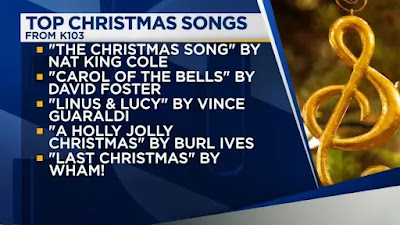
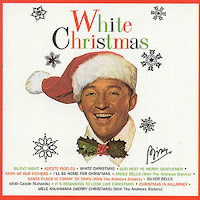
A great many people claim to hate Christmas music, but I'm not one of them. I like a lot of different kinds of music, and all the diverse genres come together most often during the holidays. Think about it. Rare is the radio station that has both Burl Ives and George Michael on its playlist, except in December, when it's not at all unusual to hear both "A Holly Jolly Christmas" and "Last Christmas", one after another, without even having to change the dial. If the different races and different creeds and different nations had the same generosity of spirit as does the average radio programmer from the day after Thanksgiving right up to December 25, the world would be a better place. 


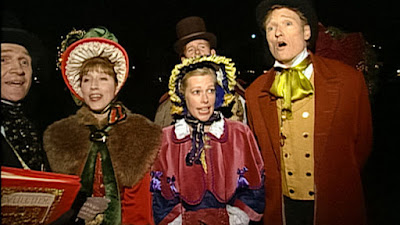
Christmas music can be divided into two broad categories: Christmas "songs" and Christmas "carols." So what's the difference between a song and a carol? Well, I've been doing all kinds of googling to find that out, and the answer is a bit unsatisfying. Historically, a carol is a song associated with a festive occasion, and Christmas certainly qualifies. But if we go by that definition, there is no difference! Any song that touches on Christmas is a carol. "Santa Baby" is a carol. "The Chipmunk Song" is a carol. "Grandma Got Run Over by a Reindeer" is a carol. Yet I can't imagine carolers such as the ones pictured above going door to door singing those songs, not without getting road salt dumped on their heads. It seems to me that no matter what it says in a dictionary, carolers use some sort of weeding out process before going out and risk having their tongues fall off from frostbite as they make their nightly rounds. After listening to Christmas songs traditionally referred to as carols and those traditionally referred to as songs, I think I've figured that weeding process out. Tradition, in fact, has a lot to do with the difference. As does technology and commercialism. Christmas songs are a relatively recent development, the product of the era of sound recording. Thomas Edison invented the phonograph in 1877, but as with so many things that have come to define modernity, the device didn't really become a consumer must-have until the 1920s (you probably weren't paying attention because of all the covid news, but modernity celebrated its 100th birthday last year.) And of course, that's also when "record" went from being a word used mostly by historians and county registrars to one that for a while there came very close to being synonymous with music itself. In the 1930s came radio, which briefly competed with the phonograph for the listeners attention, until companies such as the Radio Corporation of America found it was easy to manufacture both and use one to promote the other.  Around the same time, movies began talking, and singing. In the 1950s came television. More competition, and even more promotion. And finally, the internet. All of which increased the demand for more, and newer, music, and musical stars--everyone from Bing Crosby to Gwen Stefani--to perform it. It also meant $$$$$$$$$$, and the contracts and copyrights to make sure everyone involved gets their cut. As for Christmas, the holiday simply followed, and eventually even magnified, these trends. Yuletide may have its roots in antiquity, but today it is the very soul of modernity.


Now onto carols (and remember, this is an informal definition.) Carols go back to before the 20th century. The copyrights having long since expired, they're today all in the public domain, and though they've certainly made the transition to the phonograph and radio and television and the internet and can and are sung by pop stars, such songs were originally performed by the aforementioned carolers and church choirs. And that brings up another important difference. While there are a few that are secular in nature, such as "Deck the Halls", most carols are religious. Now, as one of the theologically uncommitted, I'm on the outside looking in, yet I can still enjoy the melodic qualities of a good religious carol and even see the appeal of the lyrical content. (A baby born in a manger grows up to be Messiah? That tops Lincoln's log cabin!) I also think carols, unfairly, are seen by some people, whatever their spiritual bent, as being kind of boring, probably because so many of us as children are forced to sing them in school or church pageants, and those wounds persist. So today what I want you to do is really listen to a carol, just one carol, but performed by three different artists or groups of artists. I don't think you'll be bored, and it just might help you overcome any traumatic childhood memories you may have of holding up a hymn book and trying to look at that and not stare at an audience of bored parents staring condescendingly back at you.


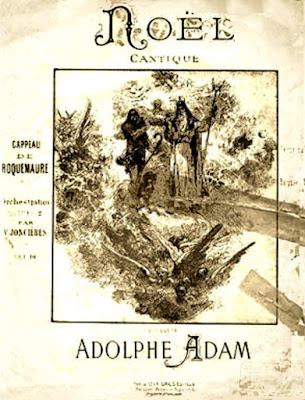
The carol I've chosen is "O Holy Night", aka, and for a very good reason aka, "Cantique de Noël" ("The Christmas Canticle".)  The original is in French, and not a song at all. It was an 1843 poem titled "Minuit, Chrétiens" ("Midnight, Christians") by Placide Cappeau, who was asked by a parish priest in the small winemaking town of Roquemaure to write something to celebrate the renovation of the church's organ. Soon thereafter, Cappeau showed his poem to Adolphe Adam (composer of the ballet Giselle), who agreed to set it to music. They were an odd pair for a church hymn. Cappeau was a political radical and ardent secularist. Adam eschewed politics but was a musical careerist who composed everything from vaudeville tunes to opera, and not a regular churchgoer. However, both were local celebrities in their day, and the priest probably thought having them aboard would be good PR, a way of getting Frenchmen into the pews between revolutions. The song eventually came to the attention of a Massachusetts-based Unitarian minister named John Sullivan Dwight, who had once taught school at the famous (if short-lived) New England Transcendentalist-friendly Brook Farm commune. After that noble social experiment unfortunately fizzled, and all those 19th century proto-hippies were forced to rejoin the Establishment, Dwight became an influential music critic, as well as the publisher and editor of Dwight's Journal of Music. In 1855, Dwight decided to translate Adam's and Cappeau's Christmas carol into English:

O holy night! The stars are brightly shining,
It is the night of our dear Saviour’s birth.
Long lay the world in sin and error pining,
‘Til He appear’d and the soul felt its worth.
A thrill of hope the weary world rejoices,
For yonder breaks a new and glorious morn.

Fall on your knees! O hear the angel voices!
O night divine, O night when Christ was born;
O night divine, O night, O night Divine.

Led by the light of Faith serenely beaming,
With glowing hearts by His cradle we stand.
So led by light of a star sweetly gleaming,
Here come the wise men from Orient land.
The King of Kings lay thus in lowly manger;
In all our trials born to be our friend.

He knows our need, to our weakness is no stranger,
Behold your King! Before Him lowly bend!
Behold your King, Before Him lowly bend!

Truly He taught us to love one another;
His law is love and His gospel is peace.
Chains shall He break for the slave is our brother;
And in His name all oppression shall cease.
Sweet hymns of joy in grateful chorus raise we,
Let all within us praise His holy name.

Christ is the Lord! O praise His Name forever,
His power and glory evermore proclaim.

Love one another? Slave is our brother? All oppression shall cease? Yeah, man, like groovy. Anyway, I don't really expect you to remember all those lyrics, but if you stick around, you'll get to hear 'em instead of read 'em. Three times in fact.


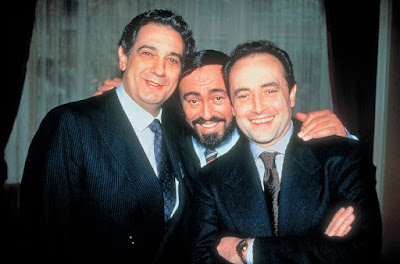
I already told you that Placide Cappeau and Adolphe Adam were celebrities in their day. Well, the 1847 premiere of "Cantique de Noël" involved yet another then-celebrity, opera singer Emily Laurey, whose name, unfortunately for her, has since slipped into obscurity (it's hard for a vocalist to attain any kind of posterity when no machine exists to record her voice.) Still, Laurey debuted the song, so as a kind of tribute to her, I've decided the first video should take place in an opera house, this one in Vienna. Placido Domingo, Luciano Pavarotti, and José Carreras, aka the supergroup The Three Tenors, sing "O Holy Night", first in its original French and then in (heavily Italian-accented) English:

Um...that was only two tenors, huh? Perhaps Mr. Carreras had a taste for an eggnog shake and snuck out to McD's. Here's hoping he makes it back in time for "Hark, the Herald Angels Sing."


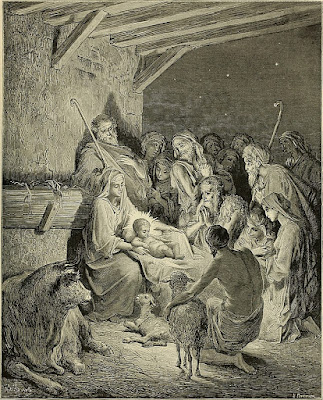
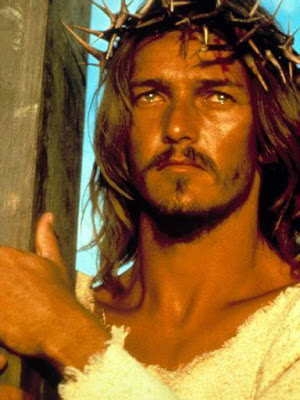
As you know, Christmas marks the birth of Jesus, pictured above. Except that's not really Jesus. Those Judean overlords the Romans may have known how to build roads and aqueducts and amphitheaters, but photography was a bit beyond them. Not that it matters. The nice thing about Christianity is that it can be so democratic at times. True, the average person can't run or cast a vote for Pope, but Christ himself is open to anyone as long as you have an Equity Card and a good agent. You don't have to be Jesus to be Jesus in a movie or rock opera or movie based on a rock opera. So, lower your heads, my children, Ted has arrived

Pretty spirited, even holy spirited, performance, but does he think he's what they say he is?


Oh, don't worry, I'm not going all secular on you. I said it's an O Holy Night and it's gonna be an O Holy Night. In fact, once Mariah gets out of her jammies and into something more form-fitting, she's headed for church:

I don't know if it's all she wants for Christmas, but Mariah just gave that old carol some soul.

Wednesday, September 29, 2021

Awesome Audio (Delta Demons and Divinities Edition)


 Early rock 'n' roller and country music star Jerry Lee Lewis was born on this day in 1935 (he died in...Oh, wow, he's still alive.) He's had many hit records in both genres, but it's his life outside the recording studio and away from the stage that interests me today. In the past 70 years, Lewis has married seven times, including his third marriage at age 22 to his 13-year-old cousin Myra Brown, whom he quickly remarried as the divorce from his second wife had not been finalized (though that second marriage itself also seems to have been bigamous as it took place before the divorce from his first wife had been finalized.) Lewis made a lot of money in his career, including $274,000 that he should have but didn't report to the IRS, which the agency then tried to recoup by seizing several automobiles, five motorcycles, a tractor, home entertainment equipment, jewelry, and several firearms from his ranch in Nesbit, Mississippi in 1979. Five years later, the IRS seized more property, and four years after that Lewis filed for bankruptcy, petitioning that he was $3 million in debt, $2 million of which he owed in back taxes. It wasn't just the IRS that came after him. In 1976, a drunken Lewis drove his new Lincoln Continental right into the front gates of Graceland mansion, then emerged from the wreck brandishing a pistol. Elvis Presley, watching all this on closed-circuit television, called the police. Lewis was charged with carrying a pistol and public drunkenness, his mug shot wired to newspapers around the world. Getting back to some of those multiple marriages, wife number three claimed mental and physical abuse, wife number four drowned in a swimming pool before the divorce was finalized, and wife number five was found dead in Lewis' home, from what the coroner later ruled a suicide, though journalist Richard Ben Cramer, writing in Rolling Stone, claimed it was much more violent than that, and that the always volatile Lewis was somehow involved. Now, when it comes to famous people, especially if they're show biz types, things can get exaggerated, but even if only half of what I just told you can be proven beyond doubt, then Jerry Lee Lewis, for all his talent, seems to have been a rather disreputable character. I'm certainly not going to defend him, except to point out that, whatever misdeeds he may have committed, Lewis does have his...


 ...spiritual side.

The above album came out in 1970, but Lewis' religiosity doesn't begin there. He was raised in the Assemblies of God church, a Pentecostal domination, but, perhaps unbeknownst to his devout parents, that wasn't his only influence growing up. His hometown of Faraday, Louisiana had a black juke joint called Haney's Big House that young Jerry Lee and his two cousins Jimmy and Mickey used to peek through the windows of and watch patrons dance to a style of early jazz (or swing) called boogie-woogie. If that wasn't enough, another, slightly older cousin named Carl had discovered that exact same music while visiting New York City with his father, brought it back home to Pine Bluff, Arkansas, and taught the young Jerry Lee how to play it on the piano when he came to visit. These two influences, the religious and the worldly, came to a head-on collision when Lewis at age 16 was sent by his mother to the Southwestern Bible Institute in Waxahachie, Texas, in the hope that he would become exclusively a gospel musician. But one night at a church assembly, Lewis played a wild, boogie-woogie version of "My God is Real" and was expelled from the school the next day. So he decided to try his hand (and given the way he played the piano, sometimes his foot) at secular music, eventually ending up at Sun Records in Memphis, Tennessee. However, none of this means he had left the Lord behind, as can be heard in this theologically heated exchange between Lewis and legendary Sun Records founder Sam Phillips. Listen:


So just what brought on this religious debate? Phillips was trying to convince Lewis to record this song:


Lewis thought the phrase "Balls of Fire" had something to do with Hell, and figured the whole song must be blasphemous. Eventually he was persuaded that the expression had many different... 


...connotations. "Great Balls of Fire" turned out to be Lewis' biggest hit, and remains his signature song to this very day.


  "The Bible doesn't even speak of religion. No word of religion is even in the Bible. Sanctification! Are you sanctified? Have you been saved? See, I was a good preacher, I know my Bible? I find myself falling short of the glory of God."

Jerry Lee Lewis may have committed many sins in his day, but the sin of hypocrisy wasn't among them. Oh, sure, he put out gospel records while behaving in the worst possible way outside the studio, but that's only hypocrisy if he held himself up as leading the exemplary life that those songs extoll. And he didn't. In many an interview over the years he flat out expressed doubts about the mostly secular career and mostly secular life he has chosen for himself, suggesting that when the Day of Judgement arrives, those choices would be regarded as chief among his sins. And while he may have hid things from the local sheriff and the local magistrate (or just paid them off), he would never be able to hide from God. Now, I'm not a Pentecostal. It's not my belief system we're talking here. I believe what Jerry Lee believes is nonsense. Yet I have a certain admiration for the sincerity and the fervency of those beliefs as he expressed them to Sam Phillips in that recording (while at the same time believing he should go the slammer if the worst of his alleged sins is ever proven in a court of law.) I also admire his survival skills. In 1986, Lewis was among the first ten performers inducted into the Rock and Roll Hall of Fame. Three of those inductees--Elvis Presley, Sam Cooke, and Buddy Holly--were no longer alive by then. Other than Lewis, the six living inductees were Chuck Berry, Fats Domino, Little Richard, The Everly Brothers (counted as one), James Brown, and Ray Charles. In the 35 years since that inaugural induction, six (technically seven) of those rockers have died, Don Everly just this past August 21. That leaves only Lewis. Who'da thunk he'd be the sole survivor? Jerry Lee Lewis may have run with the Devil, but he also seems to have had an angel on his shoulder.  


I'm not sure what was on his shoulder, but this extended family member is still around, too.