Showing posts with label subcultures. Show all posts

Monday, June 20, 2022

Barbary Bonhomie


Actress Olympia Dukakis was born on this day in 1931 (she died just last year, which I criminally let slide by because I was working on something else at the time.) She deservedly won a Best Supporting Actress Oscar for her role as long-suffering Italian-American wife and mother Rose Castorini in 1987's Moonstruck. As good as that movie is--one of the best films of the '80s in my opinion--I'd like to focus on an equally memorable character of hers, middle-aged, free-spirted San Francisco landlady Anna Madrigal, and that beings us to the dude right next to Dukakis, writer Armistead Maupin. Starting in 1974, Maupin took a page out of Charles Dickens and began writing a series of interconnected stories that appeared first in the Marin County-based Pacific Sun, and when that paper folded, the San Francisco Chronicle. Once Maupin had enough material, he did a bit of rewriting, and in 1978 came out with this:

The humorous and sometimes poignant adventures of a collection of straights and gays living in the City by the Bay, it proved to be a best-seller and has been followed by many sequels in the decades since. The television rights to the book was picked up by HBO, with hopes of turning it into a weekly sitcom. But the novel's casual attitude toward casual sex (particularly among gay men) made it seem less like a sure bet as Reaganites took over of the country and the AIDS pandemic began taking its deadly toll. So the rights were dropped, but then quickly picked up by...

...4? The rights were picked up by a number? Actually, it's Channel 4, a British network, and rival of the BBC, that came into existence in 1980. Tales of the City, the miniseries, made its television debut in the United Kingdom in September 1993. Four months later, it crossed the Atlantic, ending up...


...here, a chance if there ever was one for the publicly-funded, nonprofit US network to let its hair down, and get big ratings in the process (though not big enough to calm down outraged conservatives in Congress, who've made sure nothing like that would ever again be shown on a broadcasting system that gets 15% of its operating budget from the federal government, the subsequent reruns and three sequels ending up on cable instead.)

I doubt if too many Americans watching PBS' American Playhouse in 1994 realized they were viewing a British production since the whole thing seemed as American as Ernie and Bert. The following is the trailer for the 20th anniversary DVD box set, but if you were around back in the day, try to imagine seeing it for the first time during the early years of the Clinton administration:

British production notwithstanding, all those American accents would have sounded a bit odd on Masterpiece Theatre, don't you think? Of course, the nudity would have made it odder still.

You saw a few seconds of it during the trailer, but here's the scene in its entirety of the first meeting between Laura Linney's Mary Ann Singleton and Olympus Dukakis' Anna Madrigal:

Mary Ann Singleton is from Cleveland, as am I, and neither one of us can tell you what the hell that...


...Tennyson poem has to do with anything. Maybe if I google it:

How sweet it were, hearing the downward stream,
With half-shut eyes ever to seem
Falling asleep in a half-dream!
To dream and dream, like yonder amber light,
Which will not leave the myrrh-bush on the height;
To hear each other's whisper'd speech;
Eating the Lotos day by day,
To watch the crisping ripples on the beach,
And tender curving lines of creamy spray;
To lend our hearts and spirits wholly
To the influence of mild-minded melancholy;
To muse and brood and live again in memory,
With those old faces of our infancy
Heap'd over with a mound of grass,
Two handfuls of white dust, shut in an urn of brass!

I'm pretty sure lotus is some kind of drug (Anna Madrigal attaches joints to the doors of new tenants as a welcoming gift), but all this stuff about tender curving lines of creamy spray, I just don't get! Maybe if I google some more:


Hmm. It sez here it's a poem about "mariners." 

Now I get it.


Sunday, December 19, 2021

Vital Viewing (Bethlehem After Dark Edition)


A great many people claim to hate Christmas music, but I'm not one of them. I like a lot of different kinds of music, and all the diverse genres come together most often during the holidays. Think about it. Rare is the radio station that has both Burl Ives and George Michael on its playlist, except in December, when it's not at all unusual to hear both "A Holly Jolly Christmas" and "Last Christmas", one after another, without even having to change the dial. If the different races and different creeds and different nations had the same generosity of spirit as does the average radio programmer from the day after Thanksgiving right up to December 25, the world would be a better place. 


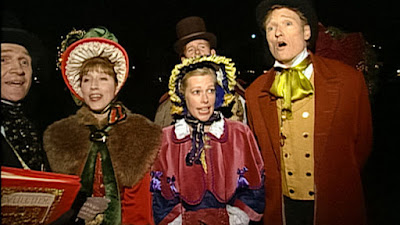
Christmas music can be divided into two broad categories: Christmas "songs" and Christmas "carols." So what's the difference between a song and a carol? Well, I've been doing all kinds of googling to find that out, and the answer is a bit unsatisfying. Historically, a carol is a song associated with a festive occasion, and Christmas certainly qualifies. But if we go by that definition, there is no difference! Any song that touches on Christmas is a carol. "Santa Baby" is a carol. "The Chipmunk Song" is a carol. "Grandma Got Run Over by a Reindeer" is a carol. Yet I can't imagine carolers such as the ones pictured above going door to door singing those songs, not without getting road salt dumped on their heads. It seems to me that no matter what it says in a dictionary, carolers use some sort of weeding out process before going out and risk having their tongues fall off from frostbite as they make their nightly rounds. After listening to Christmas songs traditionally referred to as carols and those traditionally referred to as songs, I think I've figured that weeding process out. Tradition, in fact, has a lot to do with the difference. As does technology and commercialism. Christmas songs are a relatively recent development, the product of the era of sound recording. Thomas Edison invented the phonograph in 1877, but as with so many things that have come to define modernity, the device didn't really become a consumer must-have until the 1920s (you probably weren't paying attention because of all the covid news, but modernity celebrated its 100th birthday last year.) And of course, that's also when "record" went from being a word used mostly by historians and county registrars to one that for a while there came very close to being synonymous with music itself. In the 1930s came radio, which briefly competed with the phonograph for the listeners attention, until companies such as the Radio Corporation of America found it was easy to manufacture both and use one to promote the other.  Around the same time, movies began talking, and singing. In the 1950s came television. More competition, and even more promotion. And finally, the internet. All of which increased the demand for more, and newer, music, and musical stars--everyone from Bing Crosby to Gwen Stefani--to perform it. It also meant $$$$$$$$$$, and the contracts and copyrights to make sure everyone involved gets their cut. As for Christmas, the holiday simply followed, and eventually even magnified, these trends. Yuletide may have its roots in antiquity, but today it is the very soul of modernity.


Now onto carols (and remember, this is an informal definition.) Carols go back to before the 20th century. The copyrights having long since expired, they're today all in the public domain, and though they've certainly made the transition to the phonograph and radio and television and the internet and can and are sung by pop stars, such songs were originally performed by the aforementioned carolers and church choirs. And that brings up another important difference. While there are a few that are secular in nature, such as "Deck the Halls", most carols are religious. Now, as one of the theologically uncommitted, I'm on the outside looking in, yet I can still enjoy the melodic qualities of a good religious carol and even see the appeal of the lyrical content. (A baby born in a manger grows up to be Messiah? That tops Lincoln's log cabin!) I also think carols, unfairly, are seen by some people, whatever their spiritual bent, as being kind of boring, probably because so many of us as children are forced to sing them in school or church pageants, and those wounds persist. So today what I want you to do is really listen to a carol, just one carol, but performed by three different artists or groups of artists. I don't think you'll be bored, and it just might help you overcome any traumatic childhood memories you may have of holding up a hymn book and trying to look at that and not stare at an audience of bored parents staring condescendingly back at you.


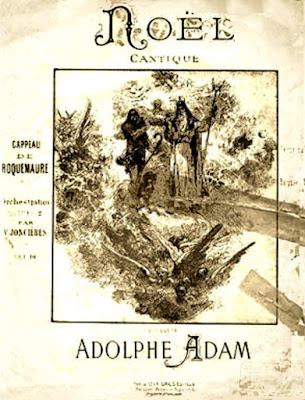
The carol I've chosen is "O Holy Night", aka, and for a very good reason aka, "Cantique de Noël" ("The Christmas Canticle".)  The original is in French, and not a song at all. It was an 1843 poem titled "Minuit, Chrétiens" ("Midnight, Christians") by Placide Cappeau, who was asked by a parish priest in the small winemaking town of Roquemaure to write something to celebrate the renovation of the church's organ. Soon thereafter, Cappeau showed his poem to Adolphe Adam (composer of the ballet Giselle), who agreed to set it to music. They were an odd pair for a church hymn. Cappeau was a political radical and ardent secularist. Adam eschewed politics but was a musical careerist who composed everything from vaudeville tunes to opera, and not a regular churchgoer. However, both were local celebrities in their day, and the priest probably thought having them aboard would be good PR, a way of getting Frenchmen into the pews between revolutions. The song eventually came to the attention of a Massachusetts-based Unitarian minister named John Sullivan Dwight, who had once taught school at the famous (if short-lived) New England Transcendentalist-friendly Brook Farm commune. After that noble social experiment unfortunately fizzled, and all those 19th century proto-hippies were forced to rejoin the Establishment, Dwight became an influential music critic, as well as the publisher and editor of Dwight's Journal of Music. In 1855, Dwight decided to translate Adam's and Cappeau's Christmas carol into English:

O holy night! The stars are brightly shining,
It is the night of our dear Saviour’s birth.
Long lay the world in sin and error pining,
‘Til He appear’d and the soul felt its worth.
A thrill of hope the weary world rejoices,
For yonder breaks a new and glorious morn.

Fall on your knees! O hear the angel voices!
O night divine, O night when Christ was born;
O night divine, O night, O night Divine.

Led by the light of Faith serenely beaming,
With glowing hearts by His cradle we stand.
So led by light of a star sweetly gleaming,
Here come the wise men from Orient land.
The King of Kings lay thus in lowly manger;
In all our trials born to be our friend.

He knows our need, to our weakness is no stranger,
Behold your King! Before Him lowly bend!
Behold your King, Before Him lowly bend!

Truly He taught us to love one another;
His law is love and His gospel is peace.
Chains shall He break for the slave is our brother;
And in His name all oppression shall cease.
Sweet hymns of joy in grateful chorus raise we,
Let all within us praise His holy name.

Christ is the Lord! O praise His Name forever,
His power and glory evermore proclaim.

Love one another? Slave is our brother? All oppression shall cease? Yeah, man, like groovy. Anyway, I don't really expect you to remember all those lyrics, but if you stick around, you'll get to hear 'em instead of read 'em. Three times in fact.


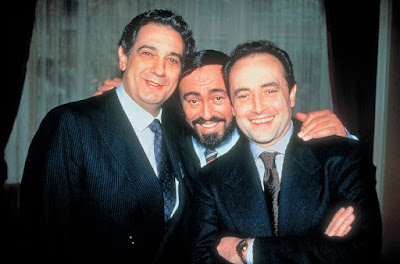
I already told you that Placide Cappeau and Adolphe Adam were celebrities in their day. Well, the 1847 premiere of "Cantique de Noël" involved yet another then-celebrity, opera singer Emily Laurey, whose name, unfortunately for her, has since slipped into obscurity (it's hard for a vocalist to attain any kind of posterity when no machine exists to record her voice.) Still, Laurey debuted the song, so as a kind of tribute to her, I've decided the first video should take place in an opera house, this one in Vienna. Placido Domingo, Luciano Pavarotti, and José Carreras, aka the supergroup The Three Tenors, sing "O Holy Night", first in its original French and then in (heavily Italian-accented) English:

Um...that was only two tenors, huh? Perhaps Mr. Carreras had a taste for an eggnog shake and snuck out to McD's. Here's hoping he makes it back in time for "Hark, the Herald Angels Sing."


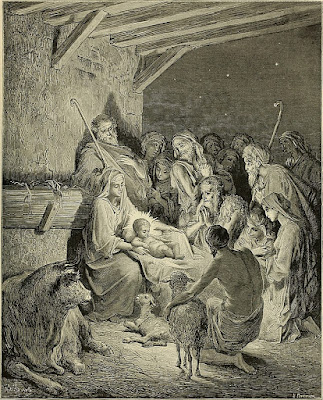
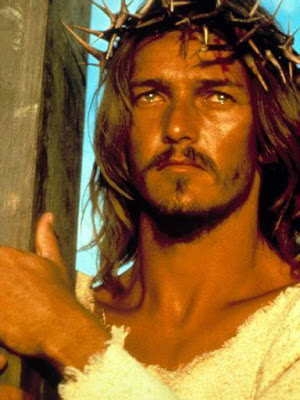
As you know, Christmas marks the birth of Jesus, pictured above. Except that's not really Jesus. Those Judean overlords the Romans may have known how to build roads and aqueducts and amphitheaters, but photography was a bit beyond them. Not that it matters. The nice thing about Christianity is that it can be so democratic at times. True, the average person can't run or cast a vote for Pope, but Christ himself is open to anyone as long as you have an Equity Card and a good agent. You don't have to be Jesus to be Jesus in a movie or rock opera or movie based on a rock opera. So, lower your heads, my children, Ted has arrived

Pretty spirited, even holy spirited, performance, but does he think he's what they say he is?


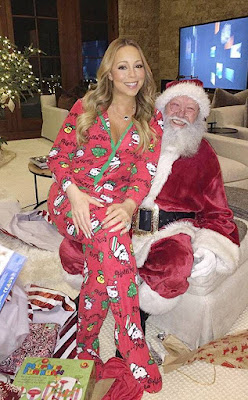
Oh, don't worry, I'm not going all secular on you. I said it's an O Holy Night and it's gonna be an O Holy Night. In fact, once Mariah gets out of her jammies and into something more form-fitting, she's headed for church:

I don't know if it's all she wants for Christmas, but Mariah just gave that old carol some soul.