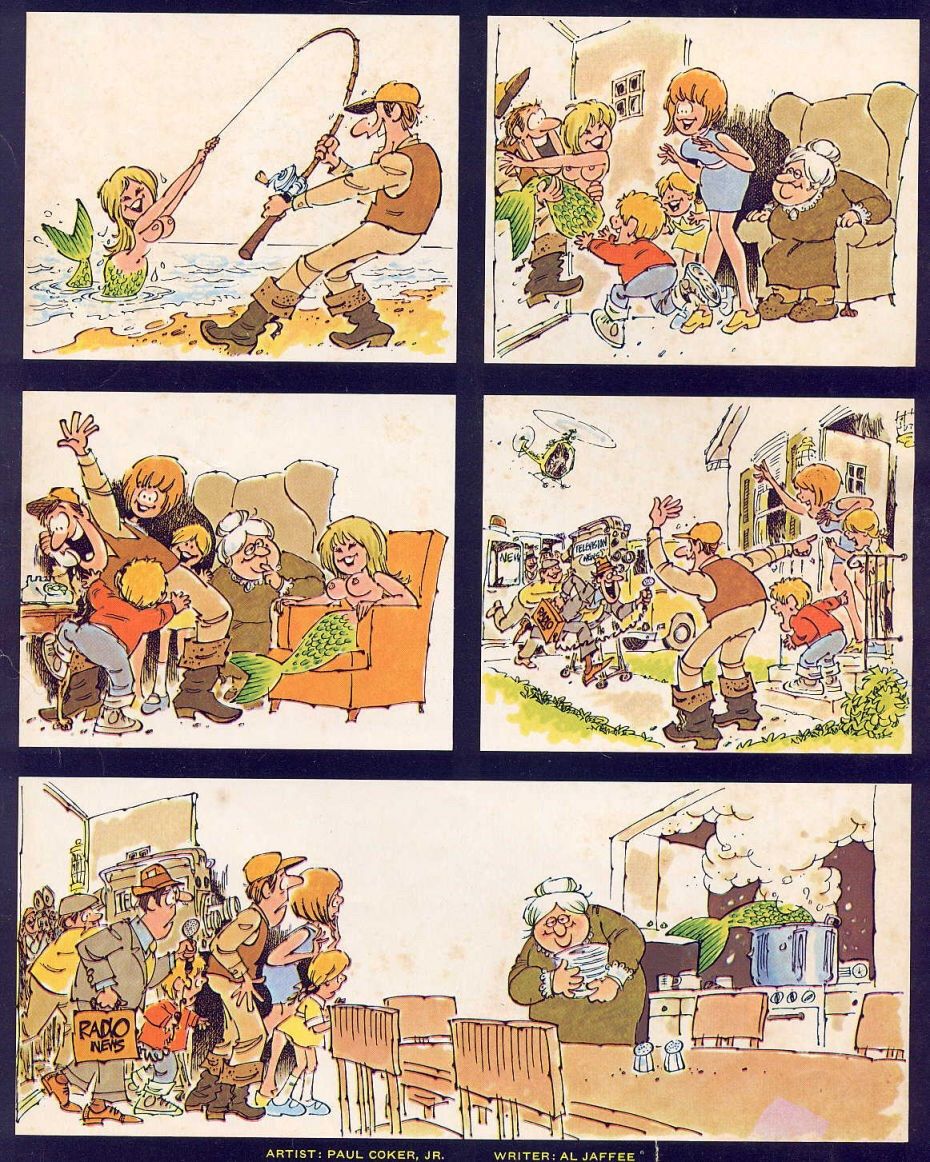
Illustrator Paul Coker Jr's remarkable career rests on three mighty pillars. In the mid-1950s he got hired on at Hallmark Cards and very soon became one of that company's top artists. His scratchy style set a tone for humorous cards that is still widely copied nearly 65 years later. If that wasn't enough, he started contributing to Mad beginning in 1960, and quickly became one of that magazine's mainstay artists. And if that wasn't enough, in the mid-1960s Rankin/Bass Productions asked Coker to design the characters for a stop-motion TV Christmas special titled Santa Claus is Coming to Town. The next year he designed the characters for the more traditionally animated Rankin/Bass TV Christmas special Frosty the Snowman, and just about everything else from that company in the decades since. Though it's his Mad work that I most cherish, the Rankin/Bass productions probably got Coker his widest audience (with the Hallmark cards a close second) and that's also what got him the following 2015 radio interview. Actually, it's kind of a behind-the-scenes radio interview that's a little like an old Bob Newhart routine where you hear only the second half of a phone conversation. But as with Newhart, that's enough:
Seems like a nice guy. Now those three pillars I mentioned:
I write to you today a letter that has been a long time coming on behalf of the Academy of Motion Picture Arts and Sciences, with humble acknowledgment of your experience at the 45th Academy Awards.
As you stood on the Oscars stage in 1973 to not accept the Oscar on behalf of Marlon Brando, in recognition of the misrepresentation and mistreatment of Native American people by the film industry, you made a powerful statement that continues to remind us of the necessity of respect and the importance of human dignity.
The abuse you endured because of this statement was unwarranted and unjustified. The emotional burden you have lived through and the cost to your own career in our industry are irreparable. For too long the courage you showed has been unacknowledged. For this, we offer both our deepest apologies and our sincere admiration.
We cannot realize the Academy’s mission to “inspire imagination and connect the world through cinema” without a commitment to facilitating the broadest representation and inclusion reflective of our diverse global population.
Today, nearly 50 years later, and with the guidance of the Academy’s Indigenous Alliance, we are firm in our commitment to ensuring indigenous voices—the original storytellers—are visible, respected contributors to the global film community. We are dedicated to fostering a more inclusive, respectful industry that leverages a balance of art and activism to be a driving force for progress.
We hope you receive this letter in the spirit of reconciliation and as recognition of your essential role in our journey as an organization. You are forever respectfully engrained in our history.
With warmest regards, David Rubin President, Academy of Motion Picture Arts and Sciences
In the first half of my life, I was best known as Florenz Ziegfeld's wife. In the second half, they remember me not as the great Ziegfeld's widow, but as Glinda the Good.
--Billie Burke
(Billie is selling herself short, at least when it comes to the "first half" of her life. Far from being just known as Florenz Ziegfeld's wife, she was a star on Broadway even before she met him, and then again in silent films. When talkies came along Billie went from being a leading lady to a character actress, but a highly sought-after character actress. Among the now-classic films she appeared in were A Bill ofDivorcement, Dinner at Eight, Topper, The Man Who Came to Dinner, and Father of the Bride. Billie was about 55 when she played Glinda the Good Witch in The Wizard of Oz. The year was 1939, but it didn't become her signature role until the film began being shown regularly on television, beginning in 1956. Billie Burke died in 1970 at the age of 85--Kirk)
The Royal Academy of Arts-trained actor David Warner didn't always play villains. Early in his career and onstage he played Hamlet, such a goody-two-shoes that it took him forever to avenge his father's death because he thought it might give him guilt pangs afterwards. In the 1976 feature film The Omen he must have been a nice enough character or why else would that little Antichrist boy have him knocked off? In Airport '79: The Concorde he's in the cockpit yukkin' it up with George Kennedy while the real villain of the piece, Robert Wagner (!) tries to shoot the supersonic aircraft out of the sky with a surface-to-air missile. In a 1984 TV version of A Christmas Carol, starring Geroge C. Scott as Scrooge, Warner plays Bob Cratchit. Now, there's nothing villainous about wanting a day off for the holiday, is there? And in the final Star Trek movie with the original TV cast, 1991's The Undiscovered Country, Warner is a good-hearted Klingon who wants peace between his Empire and the Federation. Why, if not for Warner's character, Worf might not have served alongside Picard and Data in The Next Generation!
Nevertheless, Warner's gaunt physicality and, to American ears, sometimes sinister-sounding British accent meant that he got cast more often than not as bad guys, beginning with 1963's Tom Jones as the snobby young Blifil, who conspires against the randy 18th century title character (not to be confused with the randy 20th-21st century Welsh singer.) He was Jack the Ripper transported to 1979 San Francisco in Time After Time, the digital villain Sark in Tron (1982), and a villainous valet in Titanic (1997). And Warner played the ultimate villain, Evil, in 1982's Time Bandits:
Evil doesn't understand computers? Neither do I much of the time, but gee, I like to think I'm a nice person anyway.
1939-2022
Paul Sorvino was the consummate supporting role actor, usually in dramas, but was pretty good in the occasional comedy, such as when he played the bombastic televangelist in 1977's Oh, God. There was also, a few years earlier, a rather odd made-for-TV comedy movie named It Couldn't Happen to a NicerGuy, about a middle-aged man who gets raped by a beautiful young woman, and can't get anyone to believe him. Hard to believe that last sentence, huh? I saw this when I was in the sixth grade, accepted it on its own terms, and found Sorvino as the beleaguered-in-more-ways-than-one victim funny enough in it. Were I to watch that movie again, I would like to think my reaction--no matter how funny I found Sorvino--would be What in the hell were theythinking?! Let's get back to drama, and, just this once, on safer ground. Sorvino's big break was as an ex-high school jock among several in the 1972 Broadway hit, That Championship Season, written by Jason Miller (also an actor, Miller played the young priest in The Exorcist.) In both movies and television Sorvino played cops quite a bit, including Sergeant Phil Cerreta for a single season of Law and Order. Yet from 1990 right to the day he died, Sorvino may have been best-known for not playing a cop but a man who is the target of cops (when he's not paying them off) Mafia chieftain Paul Cicero in Martin Scorsese's Goodfellas:
Don't do drugs. The mob boss as Nancy Reagan.
1945-2022
Unless there's another media retraction, Tony Dow did indeed move up to that Eisenhower-era suburb in the sky. He's best known for playing the older of two brothers in that dryly humorous family sitcom of yore, Leave It toBeaver. A father and son chat:
Kind of harsh assessment there. I think Wally may just be miffed about not being included in the show's title.
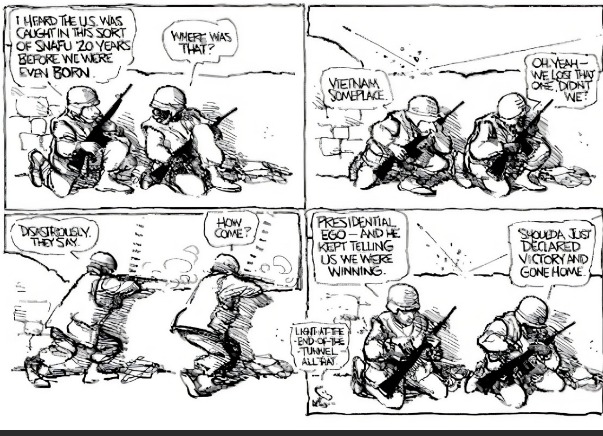
Editorial cartoonist Pat Oliphant was born on this day in Australia in 1935. He started out making fun of politics and politicians Down Under, and then in 1964 moved to the United States, just in time for the ascension of Lyndon Baines Johnson, the Vietnam War, the Civil Rights Movement, the Counterculture, and the Space Race, topics that all found their way onto his drawing board, and, through syndication, in newspapers across the land. Oliphant had been in the US just three years when he won the Pulitzer Prize for Editorial Cartooning. His career was hardly confined to the 1960s. Oliphant drew right through the Nixon, Ford, Carter, Reagan, Bush, Clinton, Bush, and Obama administrations, retiring in 2015. None of this means Oliphant's unknown or forgotten in the country in which he grew up. In fact, the following clip appeared on Australian television just two years ago. Watch:
Despite the presence of the late (he died just this past February) conservative political humorist P.J. O'Rourke in the above clip, Oliphant has described himself as a "liberal most of the time", and I think this half-century of cartoons mostly bears that out, but keep in mind that an editorial cartoonist takes shots at whoever's in power, no matter where they may be on the political spectrum:
LBJ (the president, not the basketball player) recovers from gallbladder surgery.
A war in Southeast Asia and rioting in the streets of America. Which needed troops more?
Meanwhile, this candidate had a secret plan to win the war.
The Ho Chi Mihn trail ran a lot more smoothly than the nation's highways.
Back when the South voted Democratic.
I don't think the Israelis and the Arabs disagreed for this president's benefit, but it did provide a distraction just when he needed one.
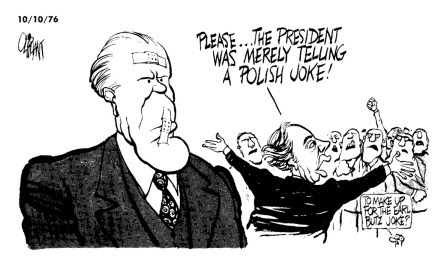
"There is no Soviet domination of Eastern Europe and there never will be under a Ford Administration."
--1976 Presidential debate.
And he did.
Just as in Aesop's fable, a virtuous ant (Jimmy Carter) triumphed over a debauched grasshopper (Teddy Kennedy)...
...not that it mattered during the general election.
Strangely enough, I couldn't find an Oliphant Iran-Contra cartoons on the web--and, trust me, folks, he did many of them--but here's at least one half of the equation.
Promises, promises.
Bill Clinton's compartmentalized view of women.
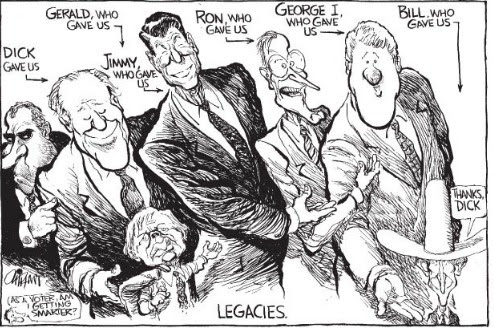
And you thought there was a lot of begetting in the Bible.
Guantanamo Bay wear.
History repeats itself...
...sort of.
The mission wasn't accomplished in New Orleans either.
From 2011. If anything, that fourth branch of government has gotten bigger in the years since.
Before the election...
...and after.
Life, liberty, and the pursuit of happiness.
This is from 2013. They've since found room for dessert.
Now I told you Pat Oliphant retired from cartooning in 2015.
In 2017, he came briefly out of retirement. Perhaps it was the threat to the republic that did it.
And finally, if you have very sharp eyes, you may have noticed a recurring character in these cartoons:
Meet Punk the penguin, Oliphant's alter ego. Just be careful you don't accidentally step on him.
I wonder if the late comedienne Phyllis Diller's penchant for wisecracks about her own homely appearance would fly today. Here's one example: "A Peeping Tom was outside my house. He asked meto pull down the shades." A person of such low self-esteem is in obvious need of a life coach. Is Tony Robbins available? Don't bother. In the middle decades of the last century Diller figured out that the best way to unleash the power within was by subverting the outwardly powers that be. With her electromagnetized hair/wig, ink blot mascara, tubercular laugh, conducting baton-length cigarette holder, and baggy Sunday funny pages-colored minidresses, Diller took the old comic hag stereotype and gave it an updated, consumerist, quasi-countercultural twist that made her one of the more memorable figures of 1960s-and-early 70s comedy and a backdoor American original. If she was self-loathing, then she loathed herself all the way to the bank. Diller was hot enough and hip enough by 1966 that the then-popular girlie magazine Playboy came to her with what must have been a rather surprising offer: a nude photo shoot. That she said yes may have been even more surprising. The whole thing was meant to be a joke, a way for the magazine to show that it could make fun of itself with the help of a woman famous for making fun of herself. Laughter, not titillation, was the goal. Diller, a veteran of the Playboy Club stand-up comedy circuit, seemed to enjoy the opportunity to appear in front of a camera wearing nothing but a Victorian-style bedspread. Unless its Hugh Hefner's beach towel. You decide:
The above photo was never published. Playboy ended up scrapping the whole idea. While a partially nude Phyllis Diller may not have been Jayne Mansfield, neither was she, when it comes to getting laughs, Phyllis Diller. And that Peeping Tom just might have kept right on peeping.




.jpg)


.jpg)









.jpeg)
