There's the Tom Jones we want! Lyricist Jones and composer Harvey Schmidt (1929-2018) cooked up twelve stage musicals together, the most well-known of which is...
...this one. Since it opened off-Broadway in 1962 and ran all the way to 2002, a total of 17,162 performances (earning the original investors a 24,000% return), it's no wonder it's the most well-known thing the two ever did. Now, as he passed away just yesterday at the age of 95, I can't really ask Mr. Jones about his book and lyrics. However, what I can do is dig up the following video from when he was still among the living and discussing his most famous work:
If you haven't seen The Fantasticks, let me sum up at least the first act. Two middle-aged fathers, one of a son and the other a daughter, decide amongst themselves that their two kids would make the perfect married couple. The problem is convincing their kids of that. Figuring that reverse psychology would work the best, they pretend to feud, thus turning the son and daughter onto the idea of forbidden love, a la Romeo and Juliet (or maybe Prince Harry and Meghan Markle.) Now that the kids are smitten, the two dads need to end the feud but not the romance. To this end they hire El Gallo, a wise, kindhearted crook with occasional godlike powers, to abduct the daughter (a scheme merrily carried out in the unfortunately titled "Rape Ballet"--try not to judge the semantics of the past too harshly, dear reader, they know not what they say.) Like a boxer in an old black-and-white movie, El Gallo takes a dive when the boy comes to rescue the girl. How can any two young lovers not stay true young lovers after all that?
Jerry Orbach, best-known for his twelve-season portrayal of wisecracking police detective Lennie Briscoe on TV's Law and Order. However, that's not his original claim to fame. Orbach was the first actor (and singer) to play El Gallo in that long-running off-Broadway production. Now, in addition to staging abductions, Gallo also serves as the musical's narrator, giving Orbach the chance to vocalize the show's most well-known number:
I personally associate the month of September not with anything to do with romance but the beginning of the school year. Hearing that song makes me want to bug my mother into buying me a new lunch box, preferably one with Snoopy, but I digress. As Jones said in that interview, The Fantasticks is both a send-up of love stories and at the same time an honest-to-goodness love story. If you pay attention to the following number closely, you can somewhat detect the send-up, but the honest-to-goodness love story is what, for the time being, wins out. Playing the young lovebirds are Matt Leisy and Juliette Trafton, both of whom appeared in a 2010 off-Broadway revival:
As you just witnessed, not only was the above off-Broadway but outside-the-theatre as well. It's actually Bryant Park in Manhattan, something for the lunch crowd before heading back to work.
Now, that happy ending Julliette Trafton refers to is not the musical as a whole, but just the first act. Things sour before--I hope I'm not giving too much away--things get better again. My final video comes before the final happy ending, and I want you to see it because, frankly, it's a hoot. What follows is a 2010 high school production featuring Sara Niemetz (who's gone onto a professional career in the theatre), and this time as El Gallo, Jacob Thomson (who doesn't appear to have turned professional, but he's pretty good anyway.) Watch:
As another Tom Jones once observed, it's not unusual to have fun with anyone.
She's best known for playing TV's Jessica Fletcher, a mystery writer who spends so much time solving mysteries one wonders when she finds time to write them, but Angela Lansbury had been acting and performing her stockings off long before that series came along. Some highlights:
Gaslight (1944)
Will a Cockney-accented Lansbury come between a French-accented Charles Boyer and a Swedish-accented Ingrid Bergman? Watch the film and find out.
The Cockney accent was real, though Lansbury eventually managed to shed it. A mere two years later, she could not only talk in an American accent but...
The Harvey Girls (1946)
...sing in one as well.
The Court Jester (1955)
With an entranced, then not entranced, then entranced again Danny Kaye. Snap!
Some more hypnotism:
The Manchurian Candidate (1962)
In this political satire disguised as a political thriller, communists infiltrate the Republican Party.
Some have called him the Moscow Candidate, but at least the infiltrators are no longer communist (small consolation to the Ukrainians.)
Halloween is only a few weeks away, so how about some...
Bedknobs and Broomsticks (1971)
...witchcraft?
As entertaining as she could be in motion pictures, Angela Lansbury was never all that big a movie star. However...
...The Great White Way was another matter.
"Life is a banquet and most poor son of a bitches are starving to death."
Um...excuse me, but I felt a sudden urge to raid the refrigerator.
BURP!
OK, I'm back. As big as a star as Angela Lansbury had been on Broadway, as I said at the top of this post, she was an even bigger star on...
...television.
That Cabot Cove looks like a nice little place to visit, huh? Just make sure you wear a bulletproof vest. Its' homicide rate would put 1970s New York City to shame.
Actor, playwright, and librettist Harvey Fierstein was born on this day in 1952. Should I include female impersonator, or is that considered an actor? It's considered a performer and performing in the guise of a woman is what Harvey did, beginning at the age of 15, at various gay venues in Manhattan. There was acting out of drag as well, and since some of that acting was in improv, he realized so too he could write. After a painful breakup with a lover, Fierstein put his acting, writing, and crossdressing skills into the one-act play International Stud, which premiered off-off-Broadway in 1978. Two one-act sequels, Fugue ina Nursery and Widows and Children First! featuring the autobiographical character he created, Arnold Beckoff, soon followed. Eventually, Fierstein decided all three one-acts could be performed in a single night:
Running for 1,222 performances, the Tonys took notice. At this point I'd like to hand it over to Wolfgang Amadeus Skywalker:
Close your eyes and you can almost hear Froggy in the later Little Rascals/Our Gang shorts, but that's part of Harvey's charm. In addition to Fierstein winning Best Actor, Torch Song Trilogy won Best Play. One of the show's producers, John Glines, acknowledged in his acceptance speech his coproducer and lover Larry Lane, a first-of-a-kind moment for a televised award show.
In 1988, the four-hour play went on a crash diet and, its overall integrity remaining intact, became a two-hour feature film:
Ya gotta love advertising. Compare the movie poster above to the Broadway poster farther up. The latter's mascaraed, peekaboo eyes seem to promise thrill-seeking patrons of The Little Theatre a walk on the wild side. Hollywood, though, appears to want to take a different tack. The wry phrasing, the camaraderie that seems to exist among the quartet of people pictured, all of it shouts out FEELGOOD MOVIE! I don't think either poster quite nails it. As provocative as the general public may have found the subject matter back in the day, Torch Song Trilogy takes a matter-of-fact look at drag shows and gay hookups, echoing its characters casual attitude towards both. As to how you should feel while watching it, the story does end on a note of cautious optimism, but that's only after first going to a very dark place. But don't let that turn you off. As a comedy-drama, it has solid laughs throughout. And since everyone loves to laugh, that's very much what's emphasized in this commercial for the stage version:
That makes it seem like a farce. All that's missing is a door slamming. To be fair, the huge bed plays quite a prominent role in the second act, the funniest of the three, though I would hesitate to call thisBob & Carol & Ted & Alicex 2. The trailer for the film version tries to restore some sense of balance between the comedy and the drama, but not at the expense, as I said before, of feeling good:
It skipped over the murder. Ya gotta love editing.
None of this is meant as a criticism of either the stage or film versions. I'm only pointing out how hard it can be to categorize (and market) the uncategorizable. But then that holds true for the LGBTQ experience in general.
There's an ongoing debate in the LGBTQ community between those who may be called assimilationists and those who may be called subculturalists. At least I'll call them that. The assimilationists believe that outside of whom one chooses to sleep with, there's essentially no difference between gays and straights, and to avoid being marginalized, it behooves gays to be as much like straights as possible, be part of the hetero-hegemonic mainstream, with all the employment opportunities and suitable housing that comes with it. It's why some lesbians wear lipstick, why some gay men look and dress like lumberjacks, and why some gay members of both genders are Log Cabin Republicans. All kidding aside, assimilation was and continues to be one of the main arguments put forth for allowing same-sex marriage (of course, there are other, more constitutional reasons, such as equal treatment under the law, and more heartfelt reasons, such as the simple act of falling in love.) I don't know that gays who raise children do it for any other reason than a strong desire to be parents, but that too puts one on equal footing with straights (though minus the happenstance that works so well for the latter group, meaning a gay either adopts or, as an added option for lesbians, undergo in vitro fertilization.) The subculturalists counter that if it's so morally wrong to bend one's sexual orientation to the will of the majority, why is it so morally right to bend in every other direction that the majority insists, and rather than be part of some Reader's Digest social order, LGBTQ people should have their own bars, their own hangouts, their own shops, their own literature, their own clothing, their own hairstyles, their own slang, their own mannerisms, and everything else that goes into the making of an alternative lifestyle (or stereotype.) Leave the kids to the breeders, and as for holding down a job and having decent housing, hey, Li'l Nas is doing very well for himself these days (just as David Bowie did before he switched over to women.)
Because Arnold Beckoff yearns for a relationship that approximates marriage and has plans on adopting a teenage boy, Torch Song Trilogy has been described as a play and movie that argues in favor of assimilation. But I think it's more complicated than that. Back in the 1980s, and maybe even today, Arnold's flamboyant, effeminate personality and occupational crossdressing would have been a tad too subcultural for the mainstream, even if he showed up at the gate in a Dodge Caravan jam-packed with all the Family Ties, Growing Pains, The Cosby Show, Who's the Boss, Full House, Charles in Charge, Mr. Belvedere, Family Matters, Life Goes On, and Our House kids combined. Arnold wants some of what straights take for granted, but on his own terms, terms that go beyond mere sleeping arrangements. He inhabits that great space in-between assimilation and subculture. Because gays are like everybody else except in those moments, in and out of the bedroom, when they're not like everyone else. Gays are the same but different. In fact, gays are the same but different from each other (as are straights.) It's why an ongoing debate in the LGBTQ community is possible in the first place. The differences and similarities are there to be seen and heard in the stage and movie versions' opening monologue. The following is obviously the result of someone pointing a video camera at a TV screen, and at an odd angle at that. But it's not the full cinematic effect that I'm after--you wouldn't get that on a computer or cell phone anyway--but Harvey Feirstein's acting and writing prowess as he recites the lines that he himself wrote:
Throughout the course of the film version, Arnold is wooed by both Matthew Broderick and Brian Kerwin, so don't feel too sorry for him.
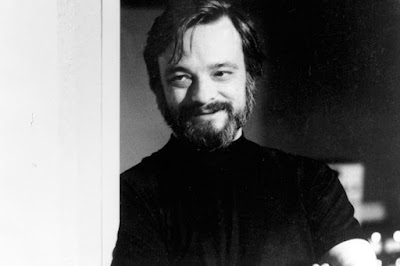
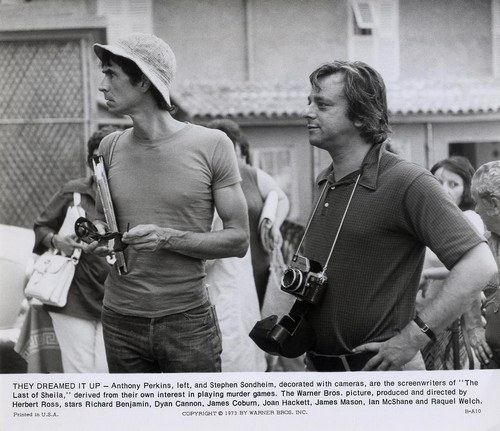
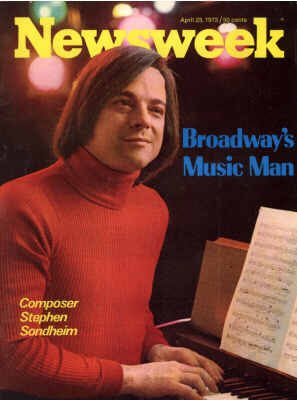
Where to begin with Broadway composer and lyricist Stephen Sondheim? How about with this interview he did with another Stephen, Stephen Colbert, back in 2011? Keep in mind this isn't Colbert's current CBS late night talk show, but his earlier one on Comedy Central where he played a mock right-wing pundit. I always found the interview segment particularly intriguing because of how deftly Colbert was able to slip in actual questions that required actual answers while keeping the overall aura of parody intact. It also required that the interviewee be a good sport about the whole thing, and Sondheim was just that:
Stephen Colbert was in a Sondheim show? This I got to see. While I look for it, here's some highlights from Stephen Sondheim's life and career...
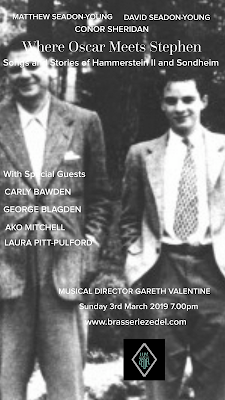
No, I'm not asking you to attend this show which was after all in March 2019, a little more than two years ago (in this age of Covid, it seems almost one hundred years ago, huh?) But it's the only picture I could find of Oscar Hammerstein II and a 16-year-old Stephen Sondheim. Hammerstein was a lyricist and librettist who had a good deal of success on Broadway in the 1920s when he teamed up with Jerome Kern to do Show Boat, a musical with an actual story and that dealt with some weighty subject matter like miscegenation and family abandonment (surprisingly, this show was produced by Florenz Ziegfeld, a man not known for social realism.) Hammerstein had a few more hits with Kern and others, but, after six flops in a row, his best days seemed past him by the start of the 1940s. Meanwhile, composer Richard Rodgers had become fed up with his longtime partner, the brilliant but alcoholic Lorenz Hart, and set about finding another lyricist. As you might have guessed, he found Hammerstein and the two set about revolutionizing the Broadway stage by specializing in the "book musical", i.e., a musical where the singing and dancing advances the plot rather than running roughshod over it. Their first big hit, Oklahoma, is a good example of this type of musical (if some cowboy sings he's having a beautiful mornin', you may be curious as to whether that's going to last into the afternoon.) As for Sondheim, born to a well-to-do family, he went to a private school where he became friends with James Hammerstein, Oscar's son. Young Stephen was already interested in musical theatre when James introduced him to his father, and now had an excellent mentor who could help him plot out his own career goals.
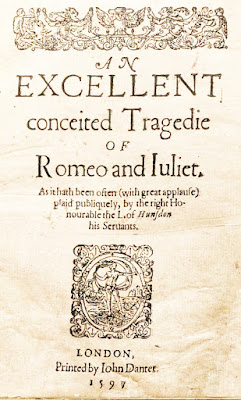
Hammerstein gave the teenager four playwriting assignments, the fourth of which, Saturday Night, was completed when Sondheim was 23. It damn near came to fruition, but the whole project fell apart when the producer died (it was finally produced in London in 1997, and has since had an off-Broadway run.) During this time Sondheim had become acquainted with the playwright Arthur Laurents (Home of theBrave.) At a party, Laurents told Sondheim about a project he, choreographer Jerome Robbins, and New York Philharmonic conductor and occasional Broadway composer Leonard Bernstein were working on that would transfer Shakespeare's Romeo and Juliet from 16th century Verona to a rough neighborhood in Manhattan where white and Puerto Rican teenage gangs vied for control of the mean streets. Laurents invited Sondheim to write the lyrics. Desiring to be both a lyricist and a composer, Sondheim's first instinct was to turn Laurents down, but decided to talk it over with Oscar Hammerstein first. "Turn itdown?!Are youkidding?!", Hammerstein responded. "This is Leonard-fucking-Bernstein!" Actually, Hammerstein didn't say that at all. I just felt the paragraph needed a little drama. He did tell the young Sondheim that given all the talent involved, this certainly would be a good learning experience, and so the Montagues and Capulets became...
...the Jets and the Sharks.
West Side Story premiered on Broadway in 1957, was a success, and became an even more successful movie in 1961. I've shown the following clip on this blog before, but it's my favorite number in the film, and gives you some idea how eventual Academy Award winner Rita Moreno (in a role originated on stage by Chita Rivera) was able to steal the whole movie right under a lip-syncing Natalie Wood's nose. Watch:
Is pro- and anti-Americanism really a gender thing?
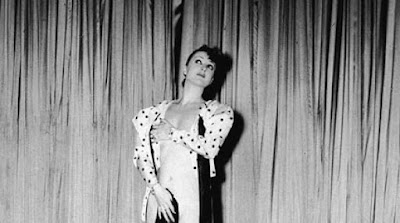
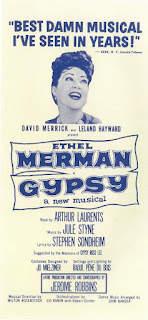
Despite West Side Story's success, Stephen Sondheim's next fifteen shows were notorious flops and he was reduced to working the ticket booth at a strip club near the airport...No, no, I'm just kidding. That's 1930s and '40s burlesque star Gypsy Rose Lee in the above photo, and that brings me to Stephen Sondheim's next major work. In 1957 Lee, whose real name was Rose Louise Hovick, wrote her autobiography, and producer David Merrick thought it would make a good musical for Ethel Merman, not as the stripper herself but her mother, the incredibly domineering Mama Rose. Merrick got the WestSide Story team of Laurents, Robbins, and Sondheim together, except this time the latter insisted he write the words and music. Merman, who seems to have been every bit as domineering in real life as the characters she regularly played, insisted the novice composer not write the music. Sondheim once again went to Hammerstein for advice. "Are you kidding?! This is Ethel-fucking-Merman!" Of course, Hammerstein didn't say that, but he did counsel Sondheim that if the show was successful, it wouldn't hurt his career any. And so, the composing chores went to the more-experienced Jule Styne. Gypsy: A Musical Fable opened on Broadway in 1959 and was indeed a success. The show was as much about Mama Rose as her wardrobe-malfunctioning daughter, but we here at Shadow of a Doubt know that sex sells, so you folks are going to get treated to an actual striptease! But which striptease? In the show Mama Rose pushes her up-to-then mostly ignored daughter Louise into burlesque only after favorite daughter June (Havoc) runs off to Hollywood to become a movie star. Louise at first is very comically nervous about disrobing on stage, but gains confidence as time goes on. I wanted the before-and-after. Sandra Church originated the role of Louise on Broadway, but on YouTube there's only a sound recording of that performance. Natalie Wood played Louise in the 1962 movie (this time in her own voice and she sounds fine) but I could only find the "after" performance. Finally, I came across this little gem which seems to have been produced only for YouTube, and stars an actress named Haley Zega. (Additional biographical detail I stumbled upon: as a six-year-old she disappeared for a couple of days in the Ozark National Forest, but fortunately was found unharmed.) Watch:
One notable difference between burlesque and latter-day strip clubs is that in the former the girls never...
...climbed up a pole and slid down. I wonder how that got started anyway. Did some enterprising strip club owner renovate an abandoned firehouse?
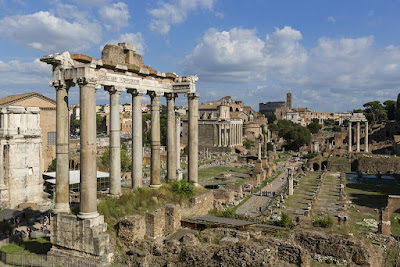
The Glory of Rome. Over the centuries it's been an inspiration for countless poems, novels, plays, movies, and multi-part PBS series. It's also inspired at least one musical-comedy, A Funny ThingHappened on the Way to the Forum. Oscar Hammerstein had died in 1960, so in 1961 or so there was so one to talk Sondheim out of insisting that he write both the words and the music, and whatever insistence he gave this time paid off. AFTHOTWTTF--even doing it with just initials tires me out--premiered on Broadway in 1962, and went on to win a Tony for best musical. Curiously, despite doing double-duty as lyricist and composer, Sondheim took home nothing. It must have been the book by Burt Shevelove and Larry Gelbart that won over Tony voters. Zero Mostel starred on stage, and, unlike Fiddler on the Roof a few years later, got to appear in the movie version as well:
After all that, it damn well better be funny. (It was.)
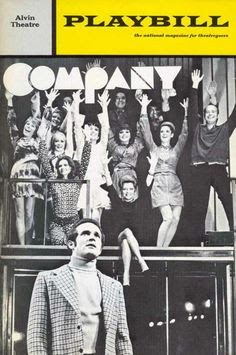
The Stephen Sondheim era really begins with the above musical that came out in 1970. Originally it was meant as a series of one-act plays by writer George Furth (also an actor, he's best known as the loyal if hapless railroad safe guard in Butch Cassidy and the Sundance Kid) that producer Harold Prince took a look at and thought would work better as a musical. Robert has just turned 35 years old and is still single--unusual for a heterosexual male back then. Really just a fear of commitment, he takes a close look at his married friends to see if he can overcome that fear. Unfortunately, their goofy unions do little to bolster his courage. We'll let Sondheim himself tell you what's at play here:
Broadway theater has been for many years supported by upper-middle-class people with upper-middle-class problems. These people really want to escape that world when they go to the theatre, and then here we are with Company talking about how we're going to bring it right back in their faces
Those upper-middle-class people Sondheim spoke of must not have minded getting their upper-middle-class problems right back in their faces, as Company's original Broadway run lasted for 705 performances. It's also been revived many times. If you watched the video at the top of this post, you'll recall Stephen Colbert was in one of those revivals. In fact, it was three nights at the New York Philharmonic in 2011 so as you can imagine this performance had quite a bit of musical accompaniment. It also had several celebrities that one doesn't normally associate with musical theatre. In addition to Colbert, there was Neil Partrick Harris (as Robert), Martha Plimpton, and Jon Cryer. All can be found in the following clip. You'll also get to see a genuine star of music theatre, and a Broadway legend at this point, Patti LuPone (unless you're an over-40 shut-in who never watches GreatPerformances in which case you may know her best as Corky's mom on Life Goes On.) Watch:
If you're surprised that Colbert can act (other than as his usual right-wing pundit character) and sing, don't be. He was a theatre major at Northwestern University.
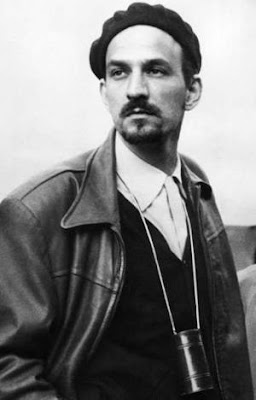
Swedish filmmaker Igmar Bergman is not someone we normally associate with Broadway musicals. Yet his 1955 movie Smiles of a Summer Night served as the basis for Sondheim's 1973 Broadway hit ALittle Night Music, which introduced what is arguably his best-known song as a lyricist and composer, "Send in the Clowns", sung here by original cast member Glynis Johns (still with us at age 98, though this particular clip is from decades ago):
I get a lot of letters over the years asking what the title means and what the song's about; I never thought it would be in any way esoteric. I wanted to use theatrical imagery in the song, because she's an actress, but it's not supposed to be a circus [...] [I]t's a theater reference meaning "if the show isn't going well, let's send in the clowns"; in other words, "let's do the jokes." I always want to know, when I'm writing a song, what the end is going to be, so "Send in the Clowns" didn't settle in until I got the notion, "Don't bother, they're here", which means that "We are the fools."
--Stephen Sondheim
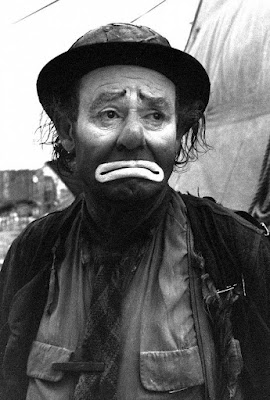
No wonder he's sad. All these years he thought that song was about him.
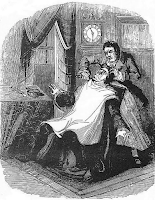
You long-haired freak! Isn't about time you went to a barber?
On second thought, never mind.
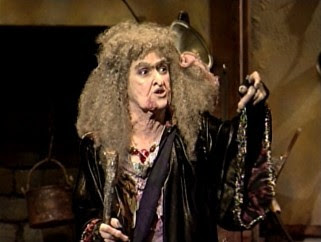
Sweeny Todd, a barber who kills people and then has a Mrs. Lovett serve them up to unsuspecting consumers as meat pies, first appeared on newsstands in 1840's London as a character in the anonymously written story "A String of Pearls" that was serialized in The People's Periodical and Family Library, a "penny dreadful", which were to Victorians what slasher films were to moviegoers in the 1980s. I myself haven't read this story, but I understand that it doesn't explain or expect readers to care about what motivates the murderous Todd any more than a Friday the 13th movie expects an audience member to care whether it gets hot under Jason Voorhees' hockey mask. Some 120 years after "A String of Pearls" appeared on the printed page, and after it was adopted for the stage many times with no other goal in mind than to scare the hell out of audiences, an Englishman named Christopher Boyd wrote a play in which he attempted to come up with a motive for Sweeny Todd and make him a somewhat sympathetic character. Sweeny has been jailed for a crime he didn't commit, and now wants to take it out on all humanity. Don't you feel sorry for him now? I don't know if Stephen Sondheim did, but he saw Boyd's play and thought it would make a nifty musical. He brought the idea to producer Harold Prince who saw in it a metaphor for the dehumanization brought on by the Industrial Revolution. As a late product of that Industrial Revolution who occasionally feels dehumanized (though I rarely do anything about it other than work on this blog), I find Prince's vision kind of compelling. However, I should warn the unsuspecting Elizabeth Warren, Bernie Sanders, or Alezandria Ocasio-Cortez voter that a scene like the one here featuring Len Cariou and Angela Lansbury, both from the original 1979 Broadway production--well, this ain't no Michael Moore movie:
Murder, She Sang.
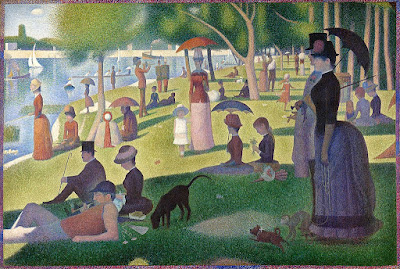
In 1985's Sunday in the Park with George, Sondheim returned to the 19th century, but a seemingly more pleasant, pastoral 19th century. George is Georges Seurat, the French post-impressionist painter who pioneered a style referred to a pointillism. Above is his most famous painting in that style, 1884'sA SundayAfternoon on the Island of La Grande Jatte. While pointillism was obviously abstract in nature--I've never met anybody in real life composed entirely of dots--Seurat relied on human models just as much as any Dutch Master or Rennaissance painter. In this clip, another genuine star of musical theatre (and veteran of many a Sondheim show) Bernadette Peters lets us know what it's like to be one of Seurat's models. Mandy Patinkan plays a preoccupied Seurat. Watch:
Somebody is suffering for somebody's art.
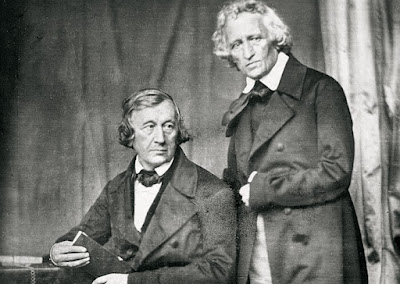
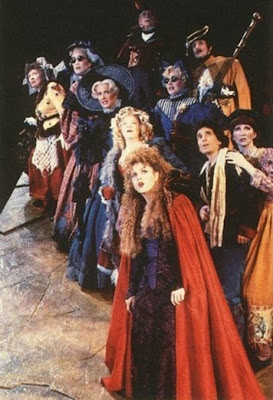
Meet Wilhelm and Jacob, 19th century German intellectuals, best known today for collecting folk stories told by non-intellectual German peasants, and then (after embellishing them a bit) publishing these stories in a series of books. You may be familiar with some of these stories: "Little Red Riding Hood" "Cinderella" "Rapunzel" and "Jack in the Beanstalk" Perhaps your parents read you these stories as a child. Perhaps you read these stories to your children. Of course, we now call such stories fairytales. Contrary to popular belief, none of Wilhelm's and Jacob's stories ended with the phrase "and they lived happily ever after", but that was the general idea. Once they stories were over, they were over. It took until 1986, over 170 years after these stories were first published, for Stephen Sondheim and librettist James Lapine to come up with a sequel.
Without giving away multiple endings, these characters tend to live crappily ever after--if they're allowed to live at all. And they find that supposedly good and noble deeds can have unintended consequences. Such as when you kill a giant, you may make a widow out of the giantess--one pissed-off widow. Maureen McGovern may have summed up this show's central message best when she sang, "There's got to be a morning after...." But Sondheim didn't write that song. So I'll give you one that he did write. And since an encore is kind of like a sequel, let's bring back Bernadette:
Uh...How about at least letting her live aesthetically ever after?
Bernadette's memory is a bit faulty here. She in fact did sing it in the show, but only a snippet as part of the finale with the whole cast singing along with her. The song as a whole was sung by actors playing Little Red Riding Hood, Cinderella, Jack the Giant Killer, and a baker who gets to meet all these famous characters. I tried looking for a clip of that, but to be honest, quickly gave up the search once I stumbled upon Bernadette's version. Call it witchcraft.
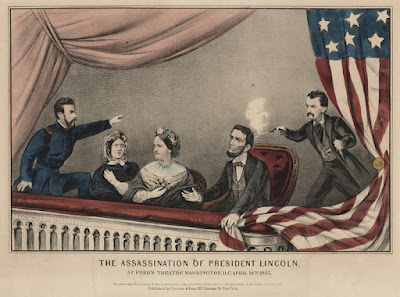
Given the parodic Stephen Colbert interview at the top of this post, you'd be forgiven if you thought a musical about assassinations was part of the joke. But it's not. There really was such a musical, Assassins, which premiered off-Broadway in 1990, and made it to the Great White Way in 2004, stopping off at London's West End in-between. The whole motley crew of presidential killers are here: John Wilkes Booth (whom we all know killed Lincoln), Charles Guiteau (whom we all may not know killed Garfield), Leon Czolgosz (McKinley), and Lee Harvey Oswald (JFK). But it doesn't stop there. Seven or eight years ago on this blog I showed a video of an editorial that TV newsman Edwin Newman gave the day Kennedy was assassinated, in which he very calmly, almost wryly, stated that if someone was determined to take out a president, at some personal risk to themselves, they had a good chance of doing so. Well, I don't know if their determination level wasn't up to snuff or what, but the fact is the would-be presidential killers slightly outnumber the successful ones, and they're represented here as well: Giuseppe Zangara (FDR), Samuel Byck (who tried but failed to hijack a plane, hoping to crash it into the Nixon White House), Squeaky Fromme (Ford), Sara Jane Moore (Ford again, just seventeen days after Fromme's attempt), and John Hinckley Jr. (Reagan). The following clip is from a San Diego production of the show:
We're always told they're loners, but look how well they work as an ensemble
Other pursuits.
In recent years Stephen Sondheim has increasingly been referred to as God by Broadway aficionados, and that almost led me to title this post "God is Dead", but I was told a German philosopher already owns the rights to that phrase. Sondheim was just a man, after all, and one whose songs often dealt with his fellow mortals falls from grace, or their failed attempts to achieve grace, usually in a non-judgmental manner. It's his effect on the theatre that's been divine. There had been others, most notably his old mentor Oscar Hammerstein II, but it was Sondheim more than anyone else who proved that a musical play can be every bit as profound and insightful as any non-musical play, or any literary novel. An American Original, his works will continue to be regularly produced for some time to come (a revival of Assassins has opened on Broadway--it got a good review in the latest issue of The NewYorker--and Steven Spielberg's remake of West Side Story hits the movie theaters next week.) And I don't know that there's anyone currently around to take his place (Andrew Lloyd Webber? He would have done so by now.) Stephen Sondheim may not have been omniscient, but in the world of musical theatre, he remains omnipresent.
Actress Ethel Barrymore, sister to Lionel and John, great-aunt to Drew, was born on this day in 1879 (she died in 1959, her life having spanned the horse-and-buggy to Cadillac-with-tailfins.) Dubbed "The First Lady of the American Theatre", she had been a star for just about the entirety of the 20th century up to that point when, in 1936 at age 56, she decided to call it quits:
If you're curious about that civil war, Ernest Hemingway turned it into a novel. Getting back to Ethel Barrymore, that retirement was a short-lived one, so short that it's not even mentioned on her Wikipedia page, her IMDb page, her Turner Classic Movies page, her Find a Grave page, or any of a half a dozen websites devoted to celebrity horoscopes. Finally, I found mention of it in her New York Times obituary. The retirement lasted a year. More like an extended leave of absence. Before giving notice, Ethel had appeared in at least 55 stage productions. After she came out of retirement, she starred in six more plays, including what turned out to be her greatest success, The Corn is Green, which ran on Broadway in three different theaters between 1940 and 1942 for a total of 477 performances. A year later, she returned to the role of Welsh schoolteacher Miss Moffat for an additional 56 performances. After that crowning achievement, there was one more Broadway production, Embezzled Heaven (sounds like The Donald Trump Story) which ran for 52 performances. By the time it ended, Ethel was almost 65. Though she was now the right age for retirement, she chose to keep on working. Unlike when she first went on stage at about age 15 in the final decade of the 19th century, there was now more options available to an actress, as long as one was reconciled to the fact that cameras don't give applause, which the reportedly no-nonsense Ethel didn't seem to mind.
Odd thing about those Barrymore siblings. We're told they dominated the Broadway stage for the first few decades of the 20th century, but that doesn't do those of us ensconced in the first few decades of the 21st much good. It's not like we can readily hop on a horse-drawn streetcar to the Garrick Theater and watch Captain Jinks of the Horse Marines. As with Sarah Siddons and Edwin Booth, we have to take it on the word of contemporary critics that Lionel's, Ethel's, and John's stage performances were all that they were cracked up to be. However, unlike Siddons, who died in 1831, or Booth, who departed this life, somewhat embarrassed by his brother's antics, in 1893, the Barrymores lived well into the 20th century, which means of course that we have their later films to give us some idea of their past glories. Actually, the stage glories and the movie glories sometimes ran parallel to each other, especially in the case of John. The youngest of the three, he became a bona fide movie star just a few years after becoming a bona fide Broadway star (by playing Hamlet.) Though his stardom came last, he was really the only one to achieve equal and simultaneous success on both stage and screen (to celebrate, he broke open the champagne, and anything else he could find in the liquor cabinet.) Lionel's film stardom is a bit more qualified. He was never quite the leading man in movies, at least not in talkies, as he had been earlier on stage. Quite handsome when he was young, he got increasingly craggier with age. If a voice can be called craggy, Lionel had that, too. Certainly it was one of the most recognizable in talkies, and that arguably made him the preeminent character actor of his day. If brother John played a dashing jewel thief in Grand Hotel and a dashing former silent screen star in Dinner at Eight, then Lionel was nonetheless was put to good use as a dying accountant in the former and a dying industrialist in the latter. Ironically, his characters are still alive at the end of each movie while John's characters are not! Lionel does die in A Free Soul (which also happened to be Clark Gable's breakthrough film), netting him an Oscar, a prize that eluded John. At awards time, it's sometimes better to have a craggy face than a great profile. So in demand was Lionel for character parts, usually supporting roles, that eventually wheelchairs were written into screenplays to accommodate his increasingly crippling arthritis.
That leaves Ethel. Of the three she had the biggest Broadway career over a longer stretch of time. By her late 40s she was already considered enough of a legend to have a theater on the Great White Way named after her (it's still there today.) Yet when it comes to film she kind of lagged behind John and Lionel, partly because she didn't care all that much about being a movie star, always holding Hollywood a bit in disdain. Not that she boycotted motion pictures altogether. Her first film, now believed lost, was 1914's The Nightingale. Thirteen more full-length movies followed, all made in the 1910s. With the exception of a single short, Camille, Ethel didn't appear on screen at all in the 1920s. Finally, in 1932, she starred with her two brothers in Rasputin and the Empress (which I wrote about way back when.) This was the second and last movie the three siblings appeared in together (the first, 1917's National RedCross Pageant, a World War I morale booster, is believed lost.) After that, Ethel stayed away from moving picture cameras for another twelve years. After which it seemed like she couldn't get enough of them. I don't know what changed exactly. Maybe the Broadway workload was a bit much for a woman closing in on 70. Ethel moved to Hollywood, a place she once compared to a "Sixth Avenue peepshow", worked in Hollywood, and eventually died in Hollywood. The first film she made after moving to the West Coast was 1944's None But the Lonely Heart, starring Cary Grant, which won her an Oscar for Best Supporting Actress. She also received Academy Award nominations for The Spiral Staircase, TheParadine Case, and Pinky. She wasn't nominated for anything, but I strongly suggest you see her in Portrait of Jennie. She's excellent as a self-described "old maid" who seems to have an unconsumated crush on a much younger Joseph Cotten (who himself has a crush on a ghost he meets in Central Park.) These movies and one or two others are Ethel's film career highlights. She also appeared in many lesser films, as money was thrown at her by producers hoping her presence in a movie would give the thing a touch of class. It was always money well-thrown. In the last fifteen years of her life, Ethel made 21 pictures.
By the late 1950s, Ethel Barrymore had survived both her brothers, and was still around to watch a nephew of hers take his own stab at stardom. Oh, well...