Though his output may seem better suited for October, it just so happens that cartoonist Charles Addams was born on this January day in 1912. Most of his cheerfully chilling single-panel cartoons appeared in The New Yorker, and after James Thurber, a special case that demands some qualifying, Addams was easily the most famous comics artist to emerge from that magazine. And while Thurber's prose now has its place in the literary canon, Addams' imagery is more firmly rooted in pop culture, even 34 years after his death. I'll show you why at the end of this post, but for now here's a 1980s interview with the macabre mirth maker:
I'm a bit disappointed that there's no philosophy of life, but absent that, we'll just have to let the work speak (or shriek) for itself:
If a few of those characters in the above cartoons look familiar, that's because there's been some...
...media crossovers.
I know Christmas is over, but I couldn't resist showing you this:
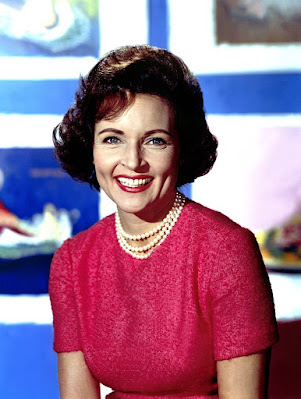
It's not the best way to ring in the new year, and I don't know that it's any consolation that it actually happened on the last day of the old year, but Betty White no longer walks the earth. Here she is in an interview that she gave about nine years ago, in which, among other things, her own pending mortality is discussed:
That interview focuses on the latter half of Betty's career, the last fifty years or so. Come to think of it, that's a lot of latter! Amazingly, she was already a celebrity at the beginning of that half-century, before she took the television roles that she's best known for today. So what happened back then that boosted her name recognition? Well, if you do a bit of research, you'll come across the following television role, one that she's no longer best known for, on the long-forgotten 1952 sitcom Life with Elizabeth (well, no long-forgotten on YouTube, where you can watch entire episodes):
Photography before smartphones.
Life with Elizabeth was a moderate success. As was a variety show that came shortly thereafter. These moderate successes added up. As did her many talk show and celebrity game show panelist appearances. Betty White was soon a household name, even if that name recognition seemed to exceed any single career accomplishment. She was well-known enough by 1963 to get this gig...
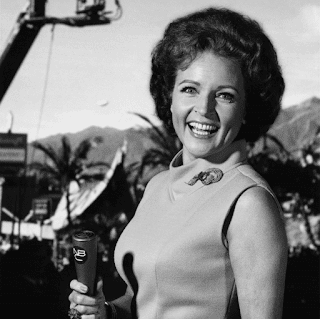
The Macy's Thanksgiving Parade, the television broadcast of which she and Bonanza star Lorne Greene co-hosted for nine years. This is probably my earliest memory of Betty White, though being of elementary school age, I was more eager to see the Bullwinkle balloon than care about who was co-hosting the event. Here's the two of them in 1972:
Watching that, I'm reminded that Betty White could also sing (and so, apparently, could Lorne.)
Though acting had been her main thing early on, by the end of the 1960s, Betty White was much more well-known for playing herself than for any fictional role. But exactly what was "herself"? Co-hosting things like the Macy's and Tournament of Roses parades, she was expected to project an upbeat image, which she may have done a bit too well, coming across to at least one person as "sickeningly sweet". Now, who in tarnation would describe her as that?
The woman on the left, that's who. A script for The Mary Tyler Moore Show called for a hostess of a WJM-TV household hints and cooking show who was perky in front of the camara but could be hard-as-nails off-camera, and sexually voracious as well. Regarding the first of those three characteristics, the perkiness, Moore suggested in a production meeting that it could be someone "like Betty White". Eventually Betty White herself was asked to play Sue Ann Nivens, the Happy Homemaker. Far from being offended at what was originally meant as a self-parody, White acted the role with gusto. That guest appearance led to another, then another, and she was eventually added to TMTMS cast. Here she is along with Ted Knight (as Ted Baxter), Ed Asner (as Lou Grant), and Gavin MacLeod (as Murray Slaughter). Watch:
The Mary Tyler Moore Show transformed White's career, wiping away the previous twenty years of real-life goody-two-shoes TV hosting, all by playing a fictional goody-two shoes TV hostess on a sitcom. How can such a thing be possible? The woman was a comic genius, that's how. Just why it was overlooked for so many decades, well, that's show biz for you.
And as a comic genius, White was no one-trick pony, though she could have easily been regarded as such had she accepted the role of Blanche Devereaux in writer-producer Susan Harris' new sitcom TheGolden Girls. Blanche was, as White said in the interview at the top of this post, a "nymphomaniac", and Sue Ann Nivens arguably had been that. Meanwhile, Rue McClanahan had been offered the part of addled-brained Rose Nyland, which was very similar to the character Vivian Harmon she had played on Maude (which starred Bea Arthur, who now headed the GG cast as Dorothy Zbornak; her mother Sophie Petrillo played by Estelle Getty.) Both wanting to do something different, White and McClanahan switched parts, and a classic sitcom was born. In this clip, Rose warns of the dangers of plastic surgery:
I'm not going to bother explaining to those who don't recognize the name just who Stepin Fetchit is, but he's not somebody you normally would associate with Norway.
Like many famous people nowadays, Betty White appeared in her very own Super Bowl commercial, in 2010:
The Saints beat the Colts that year, but all anybody was talking about the next day was the Snickers commercial, which brought the then-88-year-old White back into the public eye all over again. A successful Facebook campaign got her on Saturday Night Live, the oldest person ever to host the show (much preferrable to a later Facebook campaign that got a crooked real estate developer into the White House.) And she got one more sitcom to cap her career, as a Polish caretaker in Hot in Cleveland. For the final video, I'm not going to show you either SNL or HIC. I've used enough of your time (plus I've been sitting in this chair too long--my rump hurts.) However, I do have one final video...
In 1961, Betty White guested as a celebrity panelist on the game show Password, then at the beginning of its decades-long run. Password emcee Allen Ludden was smitten with White and kept asking her to marry him. Having walked down the aisle twice before, she was reluctant, but eventually said, "I do". They may not have been Liz and Dick, who got married a year later, but their union lasted a lot longer. On YouTube I found this pastiche of their wedded bliss, much of which also was working bliss, as they acted and otherwise appeared in a lot of shows together. It's a good a way end this:
Allen Ludden died in 1981, and never got to see Betty in The Golden Girls. If they're together now, maybe she can catch him up on all the going-ons in St. Olaf.
Tonight’s December thirty-first, Something is about to burst. The clock is crouching, dark and small, Like a time bomb in the hall. Hark, it’s midnight, children dear.
I know what you're thinking. Today is Christmas. Isn't this Revolutionary War stuff better suited for the Fourth of July? Maybe, but it just so happens that on the night of December 25, 1776, George Washington and his men crossed the Delaware River from Pennsylvania in a surprise attack on Hessian forces camped out in New Jersey, holiday be damned!
None of which means your own holiday has to be damned. After all, there hasn't been a peep out of the Hessians lately. So Merry Christmas everybody, and, please, exercise caution when handling fireworks.
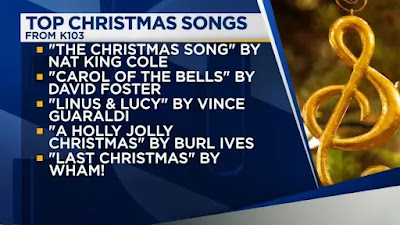
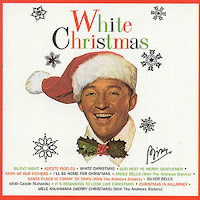
A great many people claim to hate Christmas music, but I'm not one of them. I like a lot of different kinds of music, and all the diverse genres come together most often during the holidays. Think about it. Rare is the radio station that has both Burl Ives and George Michael on its playlist, except in December, when it's not at all unusual to hear both "A Holly Jolly Christmas" and "Last Christmas", one after another, without even having to change the dial. If the different races and different creeds and different nations had the same generosity of spirit as does the average radio programmer from the day after Thanksgiving right up to December 25, the world would be a better place.
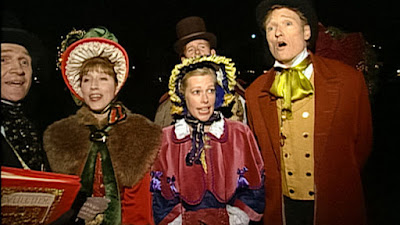
Christmas music can be divided into two broad categories: Christmas "songs" and Christmas "carols." So what's the difference between a song and a carol? Well, I've been doing all kinds of googling to find that out, and the answer is a bit unsatisfying. Historically, a carol is a song associated with a festive occasion, and Christmas certainly qualifies. But if we go by that definition, there is no difference! Any song that touches on Christmas is a carol. "Santa Baby" is a carol. "The Chipmunk Song" is a carol. "Grandma Got Run Over by a Reindeer" is a carol. Yet I can't imagine carolers such as the ones pictured above going door to door singing those songs, not without getting road salt dumped on their heads. It seems to me that no matter what it says in a dictionary, carolers use some sort of weeding out process before going out and risk having their tongues fall off from frostbite as they make their nightly rounds. After listening to Christmas songs traditionally referred to as carols and those traditionally referred to as songs, I think I've figured that weeding process out. Tradition, in fact, has a lot to do with the difference. As does technology and commercialism. Christmas songs are a relatively recent development, the product of the era of sound recording. Thomas Edison invented the phonograph in 1877, but as with so many things that have come to define modernity, the device didn't really become a consumer must-have until the 1920s (you probably weren't paying attention because of all the covid news, but modernity celebrated its 100th birthday last year.) And of course, that's also when "record" went from being a word used mostly by historians and county registrars to one that for a while there came very close to being synonymous with music itself. In the 1930s came radio, which briefly competed with the phonograph for the listeners attention, until companies such as the Radio Corporation of America found it was easy to manufacture both and use one to promote the other. Around the same time, movies began talking, and singing. In the 1950s came television. More competition, and even more promotion. And finally, the internet. All of which increased the demand for more, and newer, music, and musical stars--everyone from Bing Crosby to Gwen Stefani--to perform it. It also meant $$$$$$$$$$, and the contracts and copyrights to make sure everyone involved gets their cut. As for Christmas, the holiday simply followed, and eventually even magnified, these trends. Yuletide may have its roots in antiquity, but today it is the very soul of modernity.
Now onto carols (and remember, this is an informal definition.) Carols go back to before the 20th century. The copyrights having long since expired, they're today all in the public domain, and though they've certainly made the transition to the phonograph and radio and television and the internet and can and are sung by pop stars, such songs were originally performed by the aforementioned carolers and church choirs. And that brings up another important difference. While there are a few that are secular in nature, such as "Deck the Halls", most carols are religious. Now, as one of the theologically uncommitted, I'm on the outside looking in, yet I can still enjoy the melodic qualities of a good religious carol and even see the appeal of the lyrical content. (A baby born in a manger grows up to be Messiah? That tops Lincoln's log cabin!) I also think carols, unfairly, are seen by some people, whatever their spiritual bent, as being kind of boring, probably because so many of us as children are forced to sing them in school or church pageants, and those wounds persist. So today what I want you to do is really listen to a carol, just one carol, but performed by three different artists or groups of artists. I don't think you'll be bored, and it just might help you overcome any traumatic childhood memories you may have of holding up a hymn book and trying to look at that and not stare at an audience of bored parents staring condescendingly back at you.
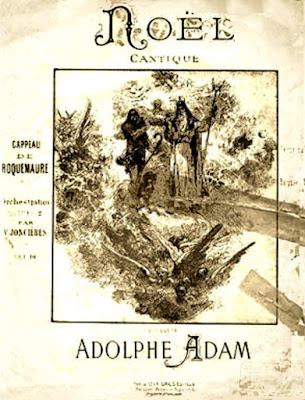
The carol I've chosen is "O Holy Night", aka, and for a very good reason aka, "Cantique de Noël" ("The Christmas Canticle".) The original is in French, and not a song at all. It was an 1843 poem titled "Minuit, Chrétiens" ("Midnight, Christians") byPlacide Cappeau, who was asked by a parish priest in the small winemaking town of Roquemaure to write something to celebrate the renovation of the church's organ. Soon thereafter, Cappeau showed his poem to Adolphe Adam (composer of the ballet Giselle), who agreed to set it to music. They were an odd pair for a church hymn. Cappeau was a political radical and ardent secularist. Adam eschewed politics but was a musical careerist who composed everything from vaudeville tunes to opera, and not a regular churchgoer. However, both were local celebrities in their day, and the priest probably thought having them aboard would be good PR, a way of getting Frenchmen into the pews between revolutions. The song eventually came to the attention of a Massachusetts-based Unitarian minister named John Sullivan Dwight, who had once taught school at the famous (if short-lived) New England Transcendentalist-friendly Brook Farm commune. After that noble social experiment unfortunately fizzled, and all those 19th century proto-hippies were forced to rejoin the Establishment, Dwight became an influential music critic, as well as the publisher and editor of Dwight's Journalof Music. In 1855, Dwight decided to translate Adam's and Cappeau's Christmas carol into English:
O holy night! The stars are brightly shining, It is the night of our dear Saviour’s birth. Long lay the world in sin and error pining, ‘Til He appear’d and the soul felt its worth. A thrill of hope the weary world rejoices, For yonder breaks a new and glorious morn.
Fall on your knees! O hear the angel voices! O night divine, O night when Christ was born; O night divine, O night, O night Divine.
Led by the light of Faith serenely beaming, With glowing hearts by His cradle we stand. So led by light of a star sweetly gleaming, Here come the wise men from Orient land. The King of Kings lay thus in lowly manger; In all our trials born to be our friend.
He knows our need, to our weakness is no stranger, Behold your King! Before Him lowly bend! Behold your King, Before Him lowly bend!
Truly He taught us to love one another; His law is love and His gospel is peace. Chains shall He break for the slave is our brother; And in His name all oppression shall cease. Sweet hymns of joy in grateful chorus raise we, Let all within us praise His holy name.
Christ is the Lord! O praise His Name forever, His power and glory evermore proclaim. His power and glory evermore proclaim.
Love one another? Slave is our brother? All oppression shall cease? Yeah, man, like groovy. Anyway, I don't really expect you to remember all those lyrics, but if you stick around, you'll get to hear 'em instead of read 'em. Three times in fact.
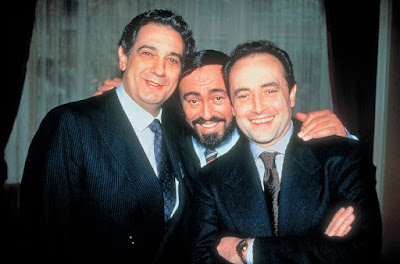
I already told you that Placide Cappeau and Adolphe Adam were celebrities in their day. Well, the 1847 premiere of "Cantique de Noël" involved yet another then-celebrity, opera singer Emily Laurey, whose name, unfortunately for her, has since slipped into obscurity (it's hard for a vocalist to attain any kind of posterity when no machine exists to record her voice.) Still, Laurey debuted the song, so as a kind of tribute to her, I've decided the first video should take place in an opera house, this one in Vienna. Placido Domingo, Luciano Pavarotti, and José Carreras, aka the supergroup The Three Tenors, sing "O Holy Night", first in its original French and then in (heavily Italian-accented) English:
Um...that was only two tenors, huh? Perhaps Mr. Carreras had a taste for an eggnog shake and snuck out to McD's. Here's hoping he makes it back in time for "Hark, the Herald Angels Sing."
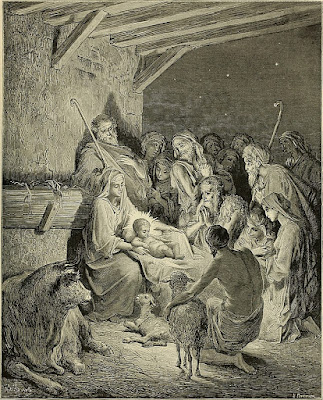
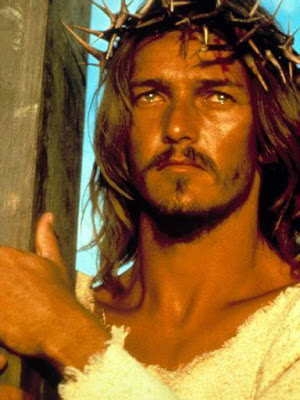
As you know, Christmas marks the birth of Jesus, pictured above. Except that's not really Jesus. Those Judean overlords the Romans may have known how to build roads and aqueducts and amphitheaters, but photography was a bit beyond them. Not that it matters. The nice thing about Christianity is that it can be so democraticat times. True, the average person can't run or cast a vote for Pope, but Christ himself is open to anyone as long as you have an Equity Card and a good agent. You don't have to be Jesus to be Jesus in a movie or rock opera or movie based on a rock opera. So, lower your heads, my children, Ted has arrived:
Pretty spirited, even holy spirited, performance, but does he think he's what they say he is?
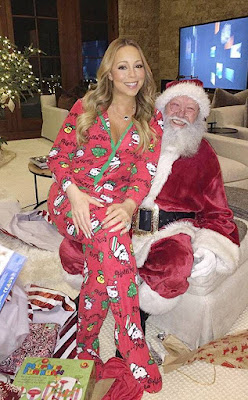
Oh, don't worry, I'm not going all secular on you. I said it's an O Holy Night and it's gonna be an O Holy Night. In fact, once Mariah gets out of her jammies and into something more form-fitting, she's headed for church:
I don't know if it's all she wants for Christmas, but Mariah just gave that old carol some soul.
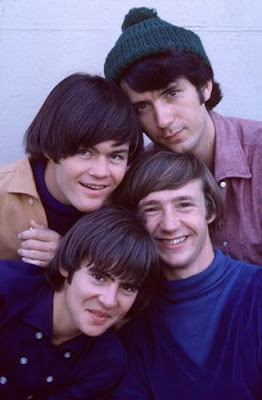
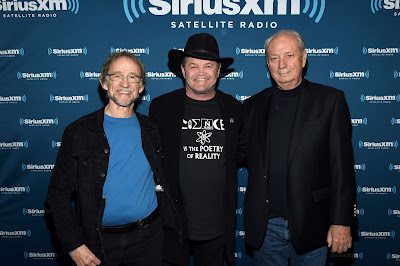
I don't think we're friends exactly. More like compatriots.
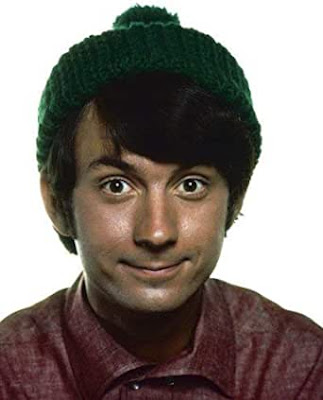
--Michael Nesmith
I never really left. It is a part of my youth that is always active in my thoughts and part of my overall work as an artist. It stays in a special place.
--Michael Nesmith
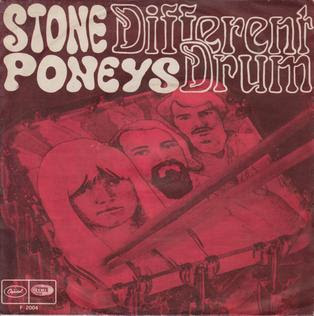
Nez once told me I should write my own songs because that's where the money is. Boy, I wish I had listened.
--Micky Dolenz
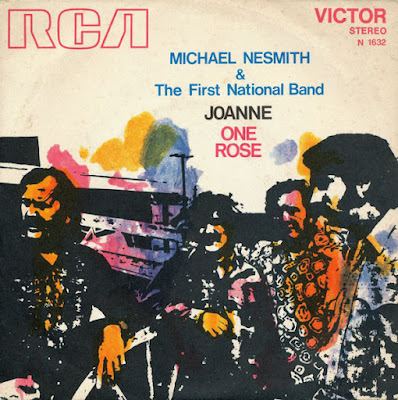
I was heartbroken beyond speech. I couldn’t even utter the words "the Eagles" and I loved Hotel California and I love the Eagles, the Flying Burrito Brothers, and the Byrds’ Sweetheart of the Rodeo, all that stuff. That was right in my wheelhouse and I was agonized, Van Gogh–agonized, not to compare myself to him, but I wanted to cut something off because I was like, "Why is this happening?" The Eagles now have the biggest-selling album of all time and mine is sitting in the closet of a closed record company?
--Mike Nesmith
(I'm assuming the closed record company Nesmith is talking about is RCA, which disappeared in 1986 after it was purchased by General Electric. His main point is that he was an early 1970s pioneer in "country rock". He did have one hit single from that period, "Joanne"--Kirk)
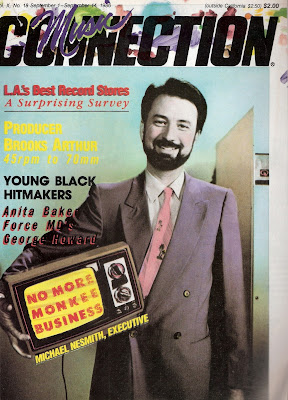
Warner Cable just watered down the idea [Popclips, a late 1970s show on Nickelodeon that Nesmithproduced] and it became MTV.