Sunday, February 20, 2022

Vital Viewing (People Will Talk Edition)


Filmmaker Robert Altman was born on this day in 1925. He died in 2006, but not before first receiving an Honorary Oscar for lifetime achievement. Lily Tomlin and Meryl Streep offer a rather lengthy introduction (which I'll explain in a bit), and then the great director himself: 

Robert Altman's revelation that he once had a heart transplant took just about anyone who recognized the name Robert Altman completely by surprise. Finding out you need a heart transplant, preparing beforehand for a heart transplant, recuperating from a heart transplant--doesn't all that take a while? No one could remember Altman being absent for any length of time. Now, he was a movie director and not a movie star, and so unlike the latter, Altman wasn't followed around by paparazzi the moment he walked off his property. Yet neither was he totally ignored by the portion of the media that covers the entertainment industry. For one thing he was a very prolific director, averaging a film a year since 1968. Some years there were two films. And there were projects for television (in the 1950s and '60s he been a prolific TV director) such as a new version of The Caine Mutiny Court-Martial (with Brad Davis in the Humphrey Bogart role) and his election year collaboration with Doonesbury cartoonist Garry Trudeau, Tanner 88, starring a favorite actor of his, Michael Murphy. Altman also had an air of motion picture historicity about him, ever since his 1970 landmark film MASH introduced, or at least emphasized as no film had before, a whole grab bag of cinematic tricks that made the "New Hollywood" landmark of a few years earlier, The Graduate, look like The Great Train Robbery. By the 1990s, moviegoers had moved on to other things, and the box office misses exceeded the box office hits. Yet no matter how commercially (though not necessarily artistically) irrelevant he became, there always was enough of a buzz about a new Robert Altman film to guarantee him a fresh round of interviews with the leading entertainment journalists. So how in the world could a heart transplant be so overlooked?


Turns out one prominent entertainment journalist WAS paying attention. On December 3, 1995, Army Archerd in his long-running Variety column reported Good wishes are out to director Robert Altman who underwent heart transplant surgery Sunday. Altman had known the surgery was necessary since last March, friends say.” Altman's wife Kathryn promptly got in touch with USA Today, and that venerable newsmagazine a few days later supposedly set the record straight: If you heard Robert Altman had a heart transplant, we happily report it’s untrue. He has heart problems, he’s fine. He’ll be fishing next week.” We now know that Mrs. Altman was less than honest with the venerable newsmagazine, as she admitted later on, "We denied it like hell." Why? According to Altman himself "There was such a stigma associated with a heart transplant at that timeHe was afraid no one would ever let him direct another film, thinking he might drop dead on the set. Well, it's understandable. Who among us hasn't fudged the truth on a job application or résumé? There's still the question of the prolific filmmaker's busy schedule. I looked up Altman's filmography, and there is in fact quite a gap between Prêt-à-Porter, which came out in December of 1994, and Kansas City, which was released in August of 1996. Had Altman been a movie star such a long absence from the public eye wouldn't have gone unnoticed, but he was a movie director, so it did. Altman lived another 11 years after his transplant, about four years short of average. However, it was not heart disease but another insidious malady that felled him: leukemia.


 We now move from the heart to another internal organ, the larynx, informally referred to as the voice box. If you're not familiar with Robert Altman's work, you may have been puzzled by Lily Tomlin's and Meryl Streep's introduction. Why were they stepping on each other's sentences? Was there static on the teleprompter? Lily and Meryl were in fact trying to evoke one of the defining features of an Altman film: overlapping dialogue. Now, Altman didn't come up with the idea. Howard Hawks used it in His Girl Friday (1940), and Orson Welles (along with every other cinematic trick) in Citizen Kane (1941). Altman, working thirty years after Hawks and Welles, had a technological advantage they lacked: multitrack recording, basically wiring each actor with a mike, taping each actor's dialogue with separate tape recorders, and later playing it all back in a sound studio, turning up the volume on the bit of dialogue most meaningful to the film. At least, I think that's how he did it. After all, I'm not a sound engineer (comment section mainstay Shady Seaweed worked in television--maybe he can elaborate.) However it was done, Altman's reasons for doing so differed from Hawks and Welles, who simply wanted to cram as much exposition as they could in a scene. Exposition never concerned Altman much. It's impossible in practice but were a 30-something Ernest Hemingway to write a one-page synopsis of MASH or McCabe & Mrs. Miller or Nashville or A Wedding and turn it in to a community college teaching assistant for grading, he would get an F for having too many meandering sentences and not coming to the point. Even if some of his movies like The Long Goodbye, The Player, or Gosford Park had something resembling a plot, it was not narrative that Altman was after but a more immersive experience for the viewer. And a voyeuristic one as well. Not in the sense of looking through a peephole, but the voyeurism that we can't but participate in when we're amongst a crowd of people, and overhear little snatches of conversation, even inconsequential snatches of conversation that would otherwise bore us if we were being addressed to directly, but paradoxically intrigue us when absorbed secondhand. However, if you just as soon be by yourself and don't want anyone else around you, avoid this potentially absorbing collection of Robert Altman's signature conversation set pieces: 

Shhhhh! I'm trying to listen.

Sunday, February 13, 2022

Smart Art (How Ya Gonna Keep 'em Down on the Farm After They've Seen Paree Edition)


I had to go to France to appreciate Iowa.

--Grant Wood, on his famous 1930 painting American Gothic, so-called because the window on the top floor of the farmhouse is in the Gothic style, much like you would see on a medieval cathedral in Europe.


The actual house, in Eldon, Iowa. Built in 1881-82, the top floor window is thought to have been purchased through a mail order catalog.


By way of comparison, the pointy arch-shaped windows of a medieval cathedral in Europe, one that very nearly burned to the ground a few years back.


These guys never made it to that Iowa farmhouse. 


Nan Goldin Graham, the artist's sister, and Dr. Byron McKeeby, the artist's dentist.


The artist himself in a 1932 self-portrait, a strapping Midwestern farm boy made good. Too strapping for some. A colleague named Lester Longman at The University of Iowa's School of Art tried to get Wood fired as a teacher, publicly citing the limitations of an artistic movement known as Regionalism, of which
American Gothic was a prime example. Yawn. However, the complaints were much less esoteric behind closed doors. Longman complained to university officials about Wood's "personal persuasions", and that he had a "strange relationship" with a man helping him write his autobiography. It didn't help matters any that some of the rural workingmen in Wood's paintings occasionally felt the need to take off their shirts as they toiled under the hot sun. Remember, this was around 80 years ago, and a least a quarter of a century before Stonewall. What for some of us today is another welcome addition to the growing LGBTQ roster of historical figures, and what for the art historian adds another layer of meaning to Wood's work, would have been career-damning at the time, with a possible additional visit to a jail cell or mental ward. Fortunately for the artist, nothing was ever proven, and Wood kept his job. He died of pancreatic cancer in 1942, one day short of his 51st birthday. 


As for the supposed artistic limitations of the Regionalist Movement (which also counted Thomas Hart Benton as a member), the main complaint seems to be that it romanticized rubes, celebrated unsophistication, and in its pursuit of the parochial, ignored the richness of the wider world. But perhaps Grant Wood, an American expatriate in Europe throughout much of the 1920s, appreciated how that wider world could make its way to some Iowan rube's house via a mail order catalog. Multiculturalism on the prairie.


Besides, there are some sophisticates who DO seek out the simplicities of rural living:


Nice homage, but what about the windows?


Arched, but not nearly pointy enough to be Hooterville Gothic, I'm afraid.


Monday, February 7, 2022

The Best of Times


By 2014, all of Charles Dickens' works had entered the public domain, but the lack of royalties didn't stop three of the late novelist's great-great-great grandchildren--Tom, Lydia, and Oliver--from getting a selfie taken with a then-newly unveiled statue in Portsmouth, England, the city of his birth. If talent runs in the family, these kids should have great expectations all their own. 

Monday, January 31, 2022

Archival Revival


1940-2022

Here's a Howard Hesseman post from a few years ago

Sunday, January 30, 2022

Under the Radar: Dick Miller


Quite possibly the most famous non-famous actor in the history of cinema (especially if that cinema was in the form of a grindhouse or drive-in theater), Mr. Miller was NOT born on this day in 1928, as I reported when this post first appeared (I offer an explanation to Shady in the comment section) but on Christmas Day of that year. The post stays up anyway, in the off-chance he was also born in a manger under an unusually large star. Now to the matter at hand. Appearing in what in the latest tally is an astonishing 180 movies, more often than not in bit parts, by the end of the 20th century Miller had become a favorite of directors who felt his five-to-ten-minutes cameos gave their films a certain back alley hipness. In the following clip, the Great Man himself talks about his surreptitious rise to cult stardom:

He played both a Cowboy and an Indian, and got to shoot himself? Now who would have him do that?

Why, this enterprising young filmmaker, that's who! Unfortunately, I can't show you that Miller-shooting-Miller scene (unless I show you the whole hour-and-a-half movie), but since Robert Corman above is known more for his science-fiction and horror films than his westerns, I'll instead give you this clip from 1957's Not of this Earth:

Such is the fate of the B-movie bit player, always getting offed by this monster or that alien, but sometimes even bit player gets to star in a classic all his own:


  I saw the best minds of my generation destroyed by madness, starving hysterical naked,
dragging themselves through the negro streets at dawn looking for an angry fix,
angelheaded hipsters burning for the ancient heavenly connection to the starry dynamo in the machinery of night who poverty and tatters and hollow-eyed and high sat up smoking in the supernatural darkness of cold-water flats floating across the tops of cities contemplating jazz 

OK, Mr. Ginsberg wasn't talking about a movie when he composed the above lines, but still, it's as good as any a description of this particular one:

Written by Corman's main screenwriter of that period, Charles B. Griffith (the exploitation film's answer to Ben Hecht), 1959's A Bucket of Blood is both a humorous look at the Beat Movement and a genuine horror movie that seeks to cash in on 1953's House of Wax, with corpses-as-statues instead of corpses-as-mannequins. But the biggest difference between the two films is whereas the villain of Wax is an appropriately sinister Vincent Price, the villain of Blood doesn't seem much like a villain at all! Miller's Walter Paisley is just some poor schnook who stumbles his way into committing acts of real evil. You've heard of the bad guy you love to hate? This is the bad guy you feel sorry for, the psychopathic murderer that just couldn't get a decent break. There but for the grace of Satan goes I. A Bucket of Blood came and went (while still making a profit, thanks to its shoestring budget.) As with The Little Shop of Horrors, another Corman-Griffith collaboration, Blood's real effect was on a later generation of filmmakers, who likely caught both films in that cultural safety net of last resort, television. As a kind of tribute to this movie, Dick Miller would be asked to play a character named Walter Paisley five more times throughout his career. Though it technically wasn't the same Walter Paisley each time out, that's still more often than Daniel Craig played a character named James Bond.


A Bucket of Blood having failed (at least in the short run) to make him a star, Dick Miller went back to supporting roles, and not just on the big screen but...


...the small one as well.


The names have been changed to protect the innocent...from embarrassment.


Joe Dante got his start editing trailers for Roger Corman, which of course meant he spent much time watching Dick Miller. In 1976, Dante and Allan Arkush codirected Hollywood Boulevard, a satire of Corman's budget-conscious New World Pictures (for Corman's budget-conscious New World Pictures.) For the second time in his career, Miller plays a character named Walter Paisley, only now he's not a murderer, just a... 

...Hollywood agent, which has its own body count.


Remember this place? They say the Kindle drove it out of business, but I don't buy it. I think it would still be around if only an employee named...

...Walter Paisley had been recommending the reading material. From 1981's The Howling, directed by the aforementioned Joe Dante.


Speaking of aforementioned, I'd like to retreat back in time for just a second to remind you of this film, 1960's The Little Shop of Horrors. In it, Miller plays Burson Fouch, a man who likes to eat flowers (as compared to the film's main attraction, a flower that likes to eat men.) I would have loved to have shown you a clip from it, but the only one I could find was dominated by the man in the cap, actor Jonathan Haze (for just cause, as he played the movie's main character, Seymore Krelborn.) The man with the beard is Mel Welles, and the lithe young woman on the left is Jackie Joseph. In 1984... 

...Miller and Joseph were reunited during the filming of...

...Gremlins. Once again directed by Joe Dante, he gave Miller a break from the Walter Paisley moniker, and now plays a character named Murray Futterman, and Joseph is his wife Shelia.


You have to squint a bit, but as this chart illustrates, Joe Dante gave Miller a lot of work over the years.


Not that other filmmaker didn't take notice of Dick Miller's talents. The same year Gremlins came out, James Cameron had Miller perform this memorable cameo in The Terminator:

Perhaps instead of memorable, I should have said In Memoriam.


 Remember Fame? First it was a movie, then a TV series that ran for a number of years in the 1980s (which reminds me: RIP Morgan Stevens.) Seasons four through six, Dick Miller played Lou Mackie, the proprietor of a local diner where the students of the fictional New York City High School of the Performing Arts liked to hang out. In this clip Miller gets to do something that he was never asked of by American International or New World Pictures--perform a little song and dance:

That scene might have worked better had the Three Stooges sang backup for Miller.


It's Roger Corman again, this time with wife Julie, who is a producer in her own right. In 1986, she asked that audiences pay a visit to the... 

...Chopping Mall. Yes, Dick Miller is once again snuffed out, but that's just in keeping with family tradition.


Sixty years of bit parts add up, and as a result, Dick Miller received much recognition late in life. Still, you may want to ask:

Well, Dick Miller may have never received an Oscar, but in 2014 he was awarded...

...the HorrorHound Weekend Lifetime Achievement Award. Frequent employer Joe Dante was on hand to bestow the honor.


Corman and Miller also stayed in touch over the years.


Finally, on this day in 2019:


Friday, January 21, 2022

Vital Viewing (Served with Gravy and Grandiloquence Edition)


1947-2022

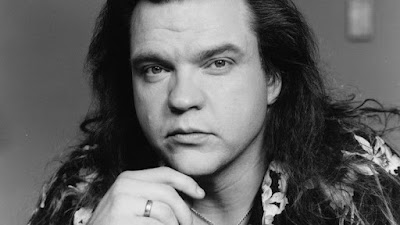
About five years ago, Texas born-and-raised rock star Meat Loaf sat down for an interview with Texas born-and-raised TV journalist Dan Rather. Where they were born and raised is about all these two men have in common, but neither seems to mind:

Did you catch that? Meat Loaf explained exactly what "that" was, so try not to forget it. As for this "Jim" person who was mentioned in passing, he would be...


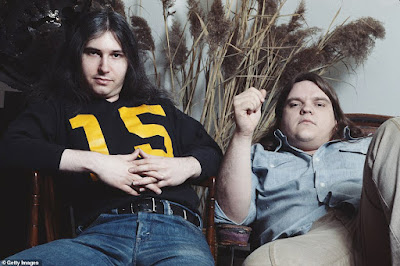
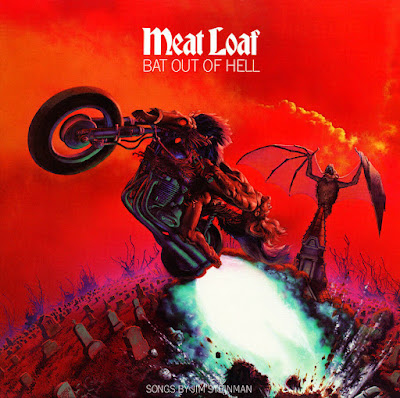
...Jim Steinman, whose death last April went unnoticed by me, or else I definitely would have done a post about him. Anyway, sometime in the early 1970s, budding young singer and actor Loaf met budding young composer Steinman. When the latter's attempt to mount a rock opera based on Peter Pan fell through, the two men decided to take several of the songs from that show and turn it into a concept album. The big labels all turned them down, so they took it to a small one, Cleveland International Records, which had recently been founded by former Columbia Records and Epic Records executive Steve Popovich, a man with a Cleveland-like surname if there ever was one (oddly enough, he was born in Pennsylvania.) Popovich took on the two young men. The 1977 result:
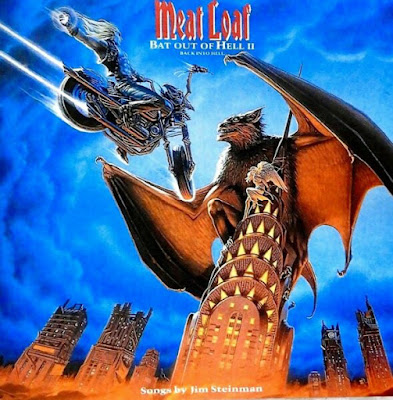
How to characterize this album? Some say it's Chuck Berry by way of Richard Wagner. Others say it's Rebel Without a Cause with a Pete Townsend score. Still others say it's an Andy Kaufman parody of Born to Run. Finally, a compelling argument can be made that producer Todd Rundgren dreamt the whole thing up while dropping acid with Peter Fonda. Whatever Bat Out of Hell is, I bought the album when I was something like 17 years old, and loved it, just loved it. All these years later, I still love it enough that I'm tempted to play all seven tracks from it. However, I should show some restraint (not that Meat Loaf or Steinman ever did) and give you just two. First up, the title track:   
I wonder if he's an organ doner.


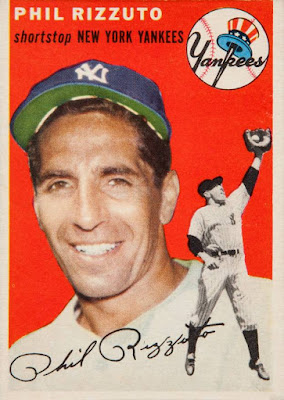
OK, sports fans, let's take a break from rock 'n' roll for just a second and look at a man who I'm told was originally a baseball player, and a very good one at that. Phil Rizzuto played shortstop for the New York Yankees from 1941 to 1956, his entire career, and a period of time when the team captured 10 American League titles and won seven World Series. Named the AL's Most Valuable Player in 1950, Rizzuto played in five All-Star Games, had a batting average of .273 with 38 home runs and 563 runs batted in, all of which I understand is to the good. As a shortstop, his 1,217 double plays rank second in major league history. Rizzuto has other impressive statistics, but I'm already in over my head, so let's cut to what he did once his ballplaying career ended.

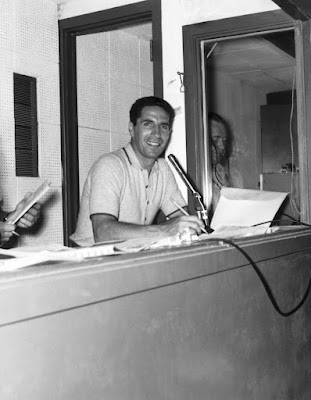
Well, like a lot of ex-athletes, Rizzuto became a broadcaster, a radio and TV announcer for the New York Yankees for nearly 40 years. An example of his play-by-play style can be heard in the following clip, but not right away as there's some musical interludes. Just be patient:

There's got to be a morning after. Or postseason.


Bat Out of Hell yielded two sequels, but it's only the first, from 1993, that I want to get into since it in turn yielded one of Meat Loaf's biggest (and at nearly 12 minutes, longest) hits. Here it is, and don't forget what Mr. Loaf told Dan Rather about "that":


Um...I'm a bit embarrassed to mention this, but I'm going to have to watch that Dan Rather interview again, because now I'm not so sure what "that" was.

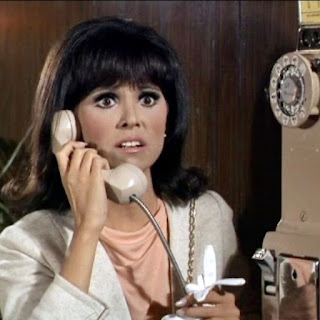
OH, WAIT! It suddenly occurred to me! The brunette in the video...

...could it have been that girl?


Wednesday, January 19, 2022

Quips and Quotations (All in What Family Edition)


Maureen Stapleton and I get confused for each other all the time! When she won an Oscar, I got so many congratulations, and as long as she's working, I don't mind being mistaken for her. But one time, she said to me, "If another jerk asks if we're sisters, I'm going to say yes--and add, 'And Jean's the one who drinks!'"

--Jean Stapleton