
"I sing to the realists; people who accept it like it is."

Though she was born in Memphis, Tennessee, Aretha grew up in Detroit, Michigan.

Now, I'm sure you associate Detroit largely with the automobile industry, but as far as I know Studebaker, De Sotos, and certainly not Edsels had any affect on Aretha's formative years, but the above building, home of the New Bethal Baptist Church, most certainly did.

When Franklin wasn't talking, he was singing:
Whether you're a true believer or not, you have to admit that a strong pair of vocal chords ran in that family. In fact, Rev. Franklin was known in ecclesiastic circles as The Man with The Million Dollar Voice.


Daughter Aretha wasn't forgotten about. While in her teens, she began singing with her father in church, and as his fame grew, began touring with him as well.

Franklin convinced the aforementioned Battle to record his daughter. In 1956, when Aretha was just 14, she came out with her first album Songs of Faith.


John H. Hammond, whose many musical discoveries included Billie Holiday and Count Basie, produced Aretha's...
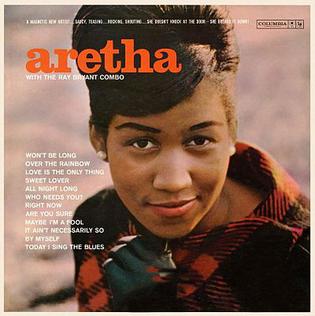
...first album, which also included...

...her first single.
Released in 1960, it reached #10 on the R+B chart.

Nevertheless, in her six years at Columbia, Aretha successes were sporadic, and in 1966...

...she decided to sign with another label.
Though headquartered in New York City, Atlantic had their new artist record not there...

...but to a place further south, in Alabama.

FAME studios, where Aretha worked with music journalist-turned music producer...

...Jerry Wexler. Back in early 1950s when he was still writing for Billboard, Wexler had coined the term "rhythm and blues". There's no evidence he also coined the term "soul music", but the white, Jewish, middle-aged Atlantic executive was one of the form's chief proponents.


 But what was soul exactly? Since the 1970s (and due largely to the efforts of one Don Cornelius) it's been an umbrella term for African-American music in general. But back in the '60s, the meaning was more specific, the music was more specific. It had something to do with the blues, but was much more melodic, not just one note endlessly repeated. On the more rousing songs, you could clap and stomp your feet. Not just the audience, but the PERFORMERS sometime did this. Actually, you might mistake the audience as part of the performance, as there seem to be a bit of shouting going back and forth from the stage to the seats and the seats to the stage. Perhaps to really understand it, you have to look at Aretha's problems at Columbia. She being black, the label pushed her into singing jazzy pop numbers, because jazz is, you know, what black people were known for. (Marian Anderson, Paul Robeson, and Leontyne Price might have had some other ideas.) And Aretha was a pretty good jazz/pop singer, but it's not what she was raised on. Nor was, for that matter, Ray Charles, who wasted a lot of his early career trying to sound like Nat King Cole. Many, many black artists, such as James Brown and Otis Redding, had learned how to sing in church. Sure, they may have wanted to do something less religious (and more lucrative) once they got a chance to do so, but did that really require a total retreat from their main musical training ground? The artists and producers operating out of Muscle Shoals, as well as those at Stax Records in Memphis, didn't think so. It's an oversimplification, but soul to a large extant is a secular form of African-American gospel. The emotion, the drama, the full-throated singing, the clapping, foot stomping, and if there's an audience present, the urge to call out to them expecting some sort of response. (Want to turn a gospel song into a soul song? Replace Jesus with a more earthbound lover, and Satan with a earthbound FORMER love who done you wrong. If it's a song of repentance, instead of dropping to your knees and asking the Lord for forgiveness, you promise that woman of yours that you'll no longer step out at night.) And it was just this secular gospel...

Ironically, Aretha spent but a single day in Muscle Shoals. While she looks very happy in the above picture with a group of SPACE session singers, apparently her then-husband Ted White and studio owner Rick Hall got into an argument, and the session was abandoned, but Aretha was there just long enough to record..

...what up to then was the biggest hit of her career, peaking at #9 on the pop charts.

Aretha would spend the rest of the 1960s recording up north, but she never forgot what she learned in Muscle Shoals, calling it "the turning point in my career."

I mentioned Otis Redding earlier. Today he's best known for "(Sittin' On) The Dock of the Bay" which had hit the charts after he had already died in a plane crash. But when he was still alive, he had had a bit of success with a crossover hit that had peaked at #35 on the pop charts. But another version of the same song was going to go much higher than that.

Redding's feminist anthem--well, it might not have been a feminist anthem when HE sang it--reached #1 and became her signature song.
More hits followed:


Soon, Aretha didn't just sing soul...

...she owned it.

The daughter of a famous black preacher meets one even more famous.
She sang at his funeral.
More hits followed in the 1970s:


Even when the hits stopped coming about midway through the decade, Aretha kept busy.

A return to her roots.

Aretha meets Jake and Elwood.

Aretha's father, meanwhile, continued to preach, and though obviously not the household name his daughter was, was still very popular in the black church.


On June 10, 1979, Rev. Franklin was shot twice by burglars at his Detroit home. He had been armed with a gun himself, had fired, but failed to hit anyone. He spent the next five years in a semi-coma. Upon his death, the crime became a homicide. Four men and two women were evenutally charged and found guilty ofr their participation in the crime. His four-hour funural was attended by 10,000 people. Rev. Jesse Jackson delivered the eulogy.

Nothing can replace the death of a parent, but things were otherwise looking up by 1985, Aretha, now at Arista, had her first Platinum-certified album, which included...

...this hit single.

That same year she got together with the Eurythmics...

...and put out this hit.

Aretha in the 1990s.

Aretha sings at the inauguration of the first African-American president.

It's not the branch of Christianity she was raised in, but Aretha sang for Pope Francis in 2015.

In 2016, Linwood Boulevard, where the New Bethel Baptist Church is located, was changed to C.L. Franklin Boulevard.
Aretha singing at that very place her father preached.

RIP, the Queen of Soul.


.jpg)


