
As 1960s yielded to the 1970s, a term was coined to describe the present state of the American film industry: New Hollywood. What did that mean? Well, that it was different from Old Hollywood. Different acting styles, different camera angles, different cinematography, different art direction, different screenplays, and last but not least, in fact first and foremost in most people's eyes, swear words and nudity, not seen or heard in American mainstream movies prior to 1967. And people who made these movies were seen as rebels. What's so surprising is how often so many of these New Hollywood rebels--Martin Scorsese, Francis Ford Coppola, Brian de Palma, William Freidkin, Paul Schrader, John Carpenter, John Milius, George Lucas, Steven Spielberg--expressed their love for Old Hollywood films. And then there's Peter Bogdanovich (1939-2022.) As a programmer for New York City's Museum of Modern Art in the early-to-mid 1960s, a period of time when the idea of Hollywood once having had a "Golden Age" (roughly 1930 to 1950) began to take hold, Bogdanovich curated retrospectives of such filmmaker from that era as John Ford, Alfred Hitchcock, Howard Hawks, and Orson Welles. He wrote about these directors, interviewed these directors, and actually became close friends with these directors. In particular, Orson Welles, whose last big hit was Touch of Evil in 1958 and was now spending the 1960s and '70s scrambling around looking for financing for whatever cinematic project he was working on, taking on all kinds of odd acting assignments along the way. So strapped for cash was Welles by 1972, Bogdanovich let him stay in his Bel Air mansion for a couple of years.
Wait a second. Bel Air mansion? The Museum of Modern Art pays THAT well? No, it doesn't. After having seen so many films (up to 400) and interviewing so many filmmakers, Bogdanovich decided he'd like to be a filmmaker himself, so he and his then-wife Polly moved to Hollywood. The major studios were closed off to him at first, but an independent producer and director by the name of Roger Corman was willing to give him a try. After doing a few bit parts in motorcycle and monster movies (originally an actor, he had been trained by Stella Adler, who also had taught Marlon Brando), Bog--
--hold on, my smart phone is flashing. Something to do with Sidney Poitier. I'll worry about it later--
--as I was saying, Bogdanovich got a chance to write (or cowrite with then-wife Polly) and direct 1969's Targets. An above-average, metafictional exploitation film that cannily contrasts the pending retirement of a horror movie actor with the real-world horror of a crazed sniper on the loose, it was a drive-in movie with a bloody drive-in movie climax. As is so often the case with B-movies, no matter how well-made, Targets came and went without much notice from the general public. However, the major studios DID notice Bogdanovich's talent. He signed some sort of contract and co-wrote and directed The Last Picture Show (1971), a not-so-nostalgic look at the 1950s. Like any New Hollywood movie it had swear words and nudity, but it looked like it had been directed by John Ford and was in black-and-white to boot! A big hit, it was followed by two more big hits, What's Up Doc? (1972) and Paper Moon (1973.) Peter Bogdanovich was a filmmaker to reckon with.
Or so everyone thought. His next four films were box-office flops, and a romance with a Playboy Playmate of the Year ended with a murder-suicide (though Bogdanovich himself was neither the murderer, murdered, or suicide.) He bounced back in 1985 with Mask. After that, well, Bogdanovich was pretty much like his old friend Orson Welles, scrambling around looking for the right comeback film. It never happened. Now, to put this in perspective, films fail at the box office for all sorts of reasons that doesn't necessarily have anything to do with quality of the product. Some of his flops have cult followings. Some may have cult followings in the future. For now, let's look at the movies that everyone AGREES were good, and have the box office receipts to back those agreements up.
If you blinked, you may have missed that tall elderly gentleman at the end. Well, here he is again as he puts the whole film in context:
Tell them Boris sent you.
OK, those were the hits...

And now, a movie that wasn't a hit and doesn't have a cult following (unless it has a cult following for the wrong reasons), but no mention of Peter Bogdanovich's' life or career or even his times would be complete without it:
Audrey Hepburn! John Ritter! Ben Gazzara! Actors whose mere presence could make any film better, even a so-so one like They All Laughed. However, their performances aren't what makes this movie an object of morbid curiosity, but rather:


As another Golden Age filmmaker (and Bogdanovich interviewee), George Cukor, once asked in a different context, What Price Hollywood?
..............................................................................................................................................
Quips and Quotations (Dream Un-Deferred Edition)
(Yes, two posts in one. Don't blame me, blame the news cycle--Kirk)
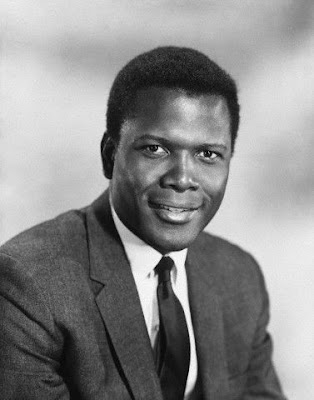 |
| 1927-2022 |
Before Sidney, African American actors had to take supporting roles in major studio films that were easy to cut out in certain parts of the country. But you couldn't cut Sidney Poitier out of a Sidney Poitier picture.
--Denzel Washington
