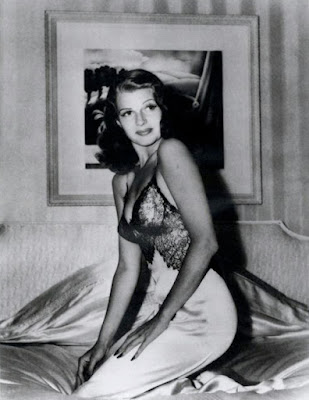
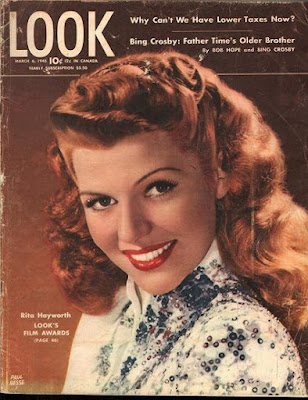
Movie star Rita Hayworth was born on this day in 1918 (she died in 1987.) The daughter of two professional dancers, she herself became a professional dancer at the age of four, appearing on Broadway with mom and dad in The Greenwich Village Follies. The family moved to Hollywood, and before she was out of her teens, Rita had signed a contract with a movie studio that eventually became 20th Century Fox. However, it was the contract that she signed a few years later with Columbia Pictures that made Rita a star. Her considerable dancing skills, acting prowess, and stunningly beautiful features made her one of the top box office draws in movie musicals throughout the 1940s. In this clip from 1942's You Were Never Lovelier, she more than holds her own along side one of the biggest movie musical stars of all time:
There you have it. Rita Hayworth in her full glory singing and dancing up a storm. In this--Oh, wait, it seems I got the weather report all wrong. Rita is still dancing up a storm, but it's...
...Big Band vocalist Nan Wynn who's doing the singing, as she had done in at least two other Hayworth musicals.
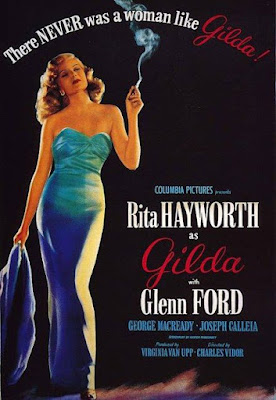
It may have been Rita's dancing (and her looks) that originally got Hollywood's attention, but her acting just got better as time went on. Soon she was in as many nonmusicals as she was in musicals, including this film noir classic:
Today, this nonmusical is musical star Hayworth's most well-known movie. If that's not ironic enough for you, this nonmusical movie about murder and betrayal and unbridled passion has in it film noir star Hayworth's most well-known musical number. Watch and listen:
You can blame the San Francisco earthquake and the Klondike shooting on Mame, but credit...
...Anita Ellis with the vocals that matched Rita's lip movements.
I wanted to study singing, but Harry Cohn kept saying, ‘Who needs it?’ and the studio wouldn’t pay for it. They had me so intimidated that I couldn’t have done it anyway. They always said, ‘Oh, no, we can’t let you do it. There’s no time for that, it has to be done right now!’ I was under contract, and that was it
--Rita Hayworth
So, does any of this matter? Was some big con job being foisted on the moviegoing public? Fictional movies are con jobs to begin with. Acting is a con job. Scripted dialogue is a con job. Anything not filmed on location, anything indoors, anything in a different historical period, anything on another planet, is a con job. Maybe con job is too harsh a word. How about make-believe? No more so than musicals which often have characters singing songs that they're supposedly making up at the spur of the moment when they could just be talking instead. As far as lip syncing goes, just about any musical made after 1935 is lip synced. Remember "Over the Rainbow" in The Wizard of Oz? No, I'm not suggesting that's not actually Judy Garland's voice you're hearing. It most certainly is, but it's not what's coming out of her mouth at the very moment she's standing on a set designed to look like a Kansas barnyard. She recorded the song a few days earlier in a recording studio so it would sound like it was recorded in a recording studio and not a Kansas barnyard or even a set made up to look like a Kansas barnyard. When it came time for the actual filming, Garland lip synced herself, which was how they did it in movies then and how they do it in music videos now. You'd have to go back to the early days of sound film to find songs sung as the camera was still rolling. The first sound picture, in fact. In The Jazz Singer, when Al Jolsen sings "Mammy" he's doing so live on film (as contradictory as that may sound.) And frankly, Al sounds better in his later movies than he does there (he comes across as less racist, too.) Once Hollywood decided that what you're seeing and what you're hearing can best be done at two different locations at two different times, it wasn't long before it occurred to somebody that what you're seeing and what you're hearing can occasionally be done by two different people as well. Rita Hayworth was a terrific dancer with a terrific screen presence whose singing wasn't quite terrific enough. Nan Wynn and Anita Ellis were terrific singers but not dancers at all and though both appeared in movies from time to time, neither had what it took to become stars. There are only so many Judy Garlands in this world. The rest is make-believe. Or, if you prefer, con jobs.
Still, you might be curious as to just what Rita Hayworth's voice did sound like. Well, she does talk in her movies. Nobody has ever suggested that was dubbed. But what about her singing? For that we'll have to turn on the TV--early 1970s TV:
Television may be even more make-believe than the movies!
When I do these "In Memoriam" posts, I usually don't mention the deceased's name change, if any. These are more or less tributes, not full-blown biographies. If it's vitally important for you to know that Doris Day was born Doris Kappelhoff, well, you can look it up on Wikipedia. But since Conway was born right here in my hometown of Cleveland (actually, Willoughby, a suburb of Cleveland) I've decided a little more detail is necessary, since you might not get it anywhere else. First off, Tim Conway was known as Tom Conway here in Cleveland. Not that he was all that well-known here in Cleveland before he was anywhere else, but that's the name he went under when he first went on the air here.
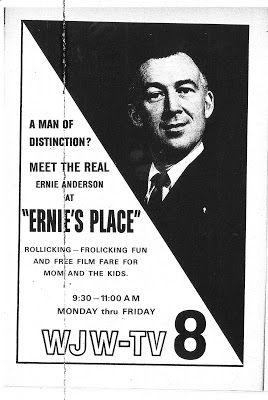
Here's what happened. Originally Conway wasn't in front of the camera but behind it. Waaay behind. Like at some desk with a typewriter. He wrote copy for the local NBC affiliate, KYC (these days it's WKYC.) It was there that he became lifelong friends with a fun-loving, deep-voiced announcer by the name of Ernie Anderson. Stories vary as to why they left the TV station, and that would be more detail than even I would want to get into, but after about a year, both ended up at local CBS affiliate WJW (these days a FOX network affiliate.) Anderson had earlier been a radio personality, excelled at ad libbing, and the station thought he might be the right person to host old movies in the afternoon hours. The show was called Ernie's Place, and one of the first things Anderson did was make sure his pal Conway got hired on as the show's director, even though he had actually no directing experience. In fact, Chuck Schodowski, a sound engineer and friend of both men who had also made the transition from KYC to WJW, did the actual directing. Anderson knew Conway to be an even better ad libber than he was, and thought they could put together Bob and Ray-like comedy routines before and after the commercial breaks. The management at WJW soon found out about this little scam, but kept Conway on anyway, since their comedy bits did seem to attract a following. As it happened, it caught the attention of ex-child star and current sitcom performer Rose-Marie, who was in town to drum up support for the first season of The Dick Van Dyke Show, where she played wisecracking Sally Rogers. Rose-Marie was impressed by Conway, and took a tape of Ernie's Place back home to Hollywood, where she showed it to the then-popular TV personality Steve Allen. Equally impressed, Allen asked Conway to be a cast member of his variety show. Amazingly, Conway was reluctant to take the job. Anderson wouldn't be going (Allen considered him to be a mere straight man), and he enjoyed working with him. Conway took his misgivings to WJW's station manager, who replied that this was too good an opportunity to pass up, and promptly fired him for lying on his resume about being a director! So Conway went out west.
Here's where we come to the name change. There already was a then-famous, now-obscure actor named Tom Conway (brother of the then-famous, now-obscure actor George Sanders), so the Tom Conway from Cleveland became Tim Conway of Hollywood. Unfortunately, the newly-christened Tim Conway's career as a Steve Allen Show player lasted a mere fourteen episodes. After a six-year run (five on NBC and one on ABC), the variety show was cancelled, and at that point it probably did seem this was indeed an opportunity that he could have passed up. Except that people in the industry were now as impressed with Conway as Rose-Marie and Allen had been. Among them the producers looking to cast a sitcom starring Ernest Borgnine that was to take place in the South Pacific during World War II, McHale's Navy. Conway was called on to play Ensign Parker, an inept junior officer. The sitcom was a minor hit, and Conway became a minor celebrity, and he would remain just that for some time to come. McHale's Navy ran for four years, after which Conway headlined a couple of other sitcoms that didn't stay on the air for very long (resulting in him ordering license plates that read "13 WKS".) Meanwhile back in Cleveland Ernie Anderson had become an extraordinarily popular late night horror movie host called Ghoulardi. But despite his success, he yearned to join his old friend Conway in Hollywood. So after four years of showing monsters movies and making fun of people who wear white socks, eat kielbasi, listen to polka music, and have pink flamingos on their front lawn (jokes only Clevelanders will get, but, hey, I'm from there), Anderson, too, headed out west. He and Conway decided to form a comedy team, and recorded two comedy albums, Are We On? and Bull! I've heard only snippets from these albums, but they're pretty funny snippets. However, you might have noticed that the comedy team of Conway and Anderson is rarely mentioned in the same breath as Laurel and Hardy, Abbott and Costello, Martin and Lewis, or even Allen and Rossi. As Conway himself put it, the albums ended up in "the browsers bin at the A+P". But it was no more of a mistake for Anderson to have left Cleveland for Hollywood than Conway (meanwhile, I've stayed behind--see what a good civic citizen I am?) He soon became one of television's most highly sought-after and highly-paid announcers. Most memorably, he instructed viewers to watch "The Lo-o-o-ve Boat." He was also the guy that would tell you who was guest-starring on The Carol Burnett Show every Saturday night. Among those guest-starring was a then-minor celebrity named Tim Conway.
It was a once-in-a-while thing at first. Two, maybe three appearances in the first season (as always, sources, especially Internet sources, vary) several more appearances the second season, then a few more the third, even more the fourth. I was in the sixth grade by the time of show's seventh season, and I swear Conway was on about every other week. Kind of a regular guest star. And usually not the only guest on any given Saturday night. Or let's put it this way, he was kind of a B guest, and a bigger star would be the A guest. In season 9 (1975-1976), right after regular Lyle Waggoner left the show, Conway went from being a frequent guest star to castmember, but no one probably noticed the promotion (or, arguably, demotion, since being a guest star was supposed to be kind of a special thing) because they thought he had already been one for years! It's hard to pin down what he did as a guest star and what he did as a cast member, but there were several recurring characters. The World's Oldest Man, who moved at the World's Oldest Snail's pace. Mr. Tudball the stuffy businessman with the odd accent. And in the Mama's Family sketches (later spun off as a sitcom) he was hard-of-hearing country yokel Mickey Hart (was Conway a Grateful Dead fan?) But mostly, there were sketches where he played one-shot characters whose main goal seem to be make Burnett castmember Harvey Korman break up laughing on the air. In fact, it's said that these sketches were taped twice, first with Conway sticking to the script, and second with Conway allowed to ad lib, and the funniest version is what ended up on the air. Much to the chagrin of Burnett's writers (some of whom also wrote for Mad magazine), the second tapings often won out.
Conway now went from being a minor to a major celebrity (so it was a promotion after all.) And he became kind of a movie star, too. It happened when he and Don Knotts were given secondary roles as two imbeciles but with one, Knotts, a more assertive imbecile than the other, a la Laurel and Hardy, in a G-rated Disney comedy titled The Apple Dumpling Gang. The movie was a surprise hit in an era when Disney rarely had hits and was constantly in danger of being gobbled up by a larger media company. That was followed by a sequel in which Conway and Knotts were now front and center, another big hit for Disney. Who knows? Perhaps Conway and Knotts were ultimately responsible for putting Disney on a sound financial footing, which eventually allowed them to expand and gobble up 20th Century Fox lo these years later. Stranger things have happened, such B-movie mogul Roger Corman snatching up Conway and Knotts and having them make a couple of G-rated films for his New World Pictures, The Private Eyes and The Prize Fighter (both co-written by Conway), and those becoming hits. It's fair to say that Tim Conway and Don Knotts were the biggest stars of the G-rated feature film in that era. Unfortunately, there was such a stigma attached to G-rated feature films in the 1970s that this meant Conway and Knotts couldn't have bit parts much less starring roles in any other-rated feature film. So they were major movies stars and box office poison at the same time. That's show biz for ya.
Tim Conway finally got to do a PG-rated movie when cult filmmaker and Corman protege Paul Bartel (Death Race 2000, Eating Raoul) agreed to direct a screenplay of his titled The Longshot, a thoroughbred racing comedy (Conway's father was a horse groomer.) I found the film funny, but it tanked at the box office, thus depriving the world, or at least the segment of the world that likes to go to midnight showings of movies, of further Conway-Bartel collaborations. So Conway went back to more innocuous fare, a good chunk of which involved a very little man with even littler feet and an odd accent, similar to Mr. Tubury's except this fellow's name was Dorf. Conway first played the character--supposedly a world-famous racehorse jockey--in a sketch on The Tonight Show Starring Johnny Carson. After that there was a how-to video parody titled Dorf on Golf that sold extremely well, leading to eight more videos, each of which had Dorf giving a lesson in a sport that he hadn't come close to mastering himself. It was shamelessly broad comedy, but the sheer technical brilliance and slapstick skill in which it was carried out--Conway had to stand in a hole with fake shoes taped to his knees--was worthy of Buster Keaton.
So what else is there? In 1999 he was reunited with his McHale's Navy castmate Ernest Borgnine, as both lent their voices to the characters Barnacle Man and Mermaid Man on the animated SpongeBob SquarePants show. And he did guest shots on a lot of other shows, both animated and live-action, picked up several cabinets-worth of Emmys and lifetime achievement awards, and was a ubiquitous pop culture presence up until about a year or so ago when declining health finally got the best of him.
For all his show biz success, I think Tim Conway was an underrated comic, and maybe even a bit of a misunderstood one. Though all his awards and I suppose his bank statement would suggest, would affirm, otherwise, and Conway himself never expressed any regrets, I can't help but wonder if his career was somewhat mismanaged. When he was on talk shows rather than in sketches, he could still be funny but funny in the course of a conversation. He actually came across as droll, even cerebral, closer to Bob Newhart than Robin Williams. What I've heard from the two comedy albums Conway did with Ernie Anderson suggests he could have gone in that direction, as they kind of remind me of the early '60s classic, The Buttoned-Down Mind of Bob Newhart. But, as I said before, no one bought Conway's albums, and he probably decided that there was only room in the entertainment mainstream for one Bob Newhart at a time. So Tim Conway broadened his shtick considerably, but never to the point where his penchant for a dryer form of comedy was completely hidden. The combination of the two worked wonders.
Earlier I mentioned a fellow by the name of Chuck Schodowski, who directed Ernie's Place, even though Conway was supposed to direct it. Well, like Ernie Anderson before him, he eventually became a late-night horror movie host. For over forty years, "Big Chuck" and, originally co-host Bob "Hoolihan" Wells, later "Little" John Rinaldi, presented Friday night viewers in Northeast Ohio Laugh-In-style blackout gags along with the usual black-and-white vampires, werewolves, and tentacled aliens. In the following two such sketches, an old friend pops up: