Wednesday, July 27, 2022

Vital Viewing (Three Times Is NOT the Charm Edition)


1941-2022

The Royal Academy of Arts-trained actor David Warner didn't always play villains. Early in his career and onstage he played Hamlet, such a goody-two-shoes that it took him forever to avenge his father's death because he thought it might give him guilt pangs afterwards. In the 1976 feature film The Omen he must have been a nice enough character or why else would that little Antichrist boy have him knocked off? In Airport '79: The Concorde he's in the cockpit yukkin' it up with George Kennedy while the real villain of the piece, Robert Wagner (!) tries to shoot the supersonic aircraft out of the sky with a surface-to-air missile. In a 1984 TV version of A Christmas Carol, starring Geroge C. Scott as Scrooge, Warner plays Bob Cratchit. Now, there's nothing villainous about wanting a day off for the holiday, is there? And in the final Star Trek movie with the original TV cast, 1991's The Undiscovered Country, Warner is a good-hearted Klingon who wants peace between his Empire and the Federation. Why, if not for Warner's character, Worf might not have served alongside Picard and Data in The Next Generation!

Nevertheless, Warner's gaunt physicality and, to American ears, sometimes sinister-sounding British accent meant that he got cast more often than not as bad guys, beginning with 1963's Tom Jones as the snobby young Blifil, who conspires against the randy 18th century title character (not to be confused with the randy 20th-21st century Welsh singer.) He was Jack the Ripper transported to 1979 San Francisco in Time After Time, the digital villain Sark in Tron (1982), and a villainous valet in Titanic (1997). And Warner played the ultimate villain, Evil, in 1982's Time Bandits: 


Evil doesn't understand computers? Neither do I much of the time, but gee, I like to think I'm a nice person anyway.


1939-2022

Paul Sorvino was the consummate supporting role actor, usually in dramas, but was pretty good in the occasional comedy, such as when he played the bombastic televangelist in 1977's Oh, God. There was also, a few years earlier, a rather odd made-for-TV comedy movie named It Couldn't Happen to a Nicer Guy, about a middle-aged man who gets raped by a beautiful young woman, and can't get anyone to believe him. Hard to believe that last sentence, huh? I saw this when I was in the sixth grade, accepted it on its own terms, and found Sorvino as the beleaguered-in-more-ways-than-one victim funny enough in it. Were I to watch that movie again, I would like to think my reaction--no matter how funny I found Sorvino--would be What in the hell were they thinking?! Let's get back to drama, and, just this once, on safer ground. Sorvino's big break was as an ex-high school jock among several in the 1972 Broadway hit, That Championship Season, written by Jason Miller (also an actor, Miller played the young priest in The Exorcist.) In both movies and television Sorvino played cops quite a bit, including Sergeant Phil Cerreta for a single season of Law and Order. Yet from 1990 right to the day he died, Sorvino may have been best-known for not playing a cop but a man who is the target of cops (when he's not paying them off) Mafia chieftain Paul Cicero in Martin Scorsese's Goodfellas

Don't do drugs. The mob boss as Nancy Reagan. 


1945-2022

Unless there's another media retraction, Tony Dow did indeed move up to that Eisenhower-era suburb in the sky. He's best known for playing the older of two brothers in that dryly humorous family sitcom of yore, Leave It to Beaver. A father and son chat:


Kind of harsh assessment there. I think Wally may just be miffed about not being included in the show's title.

Sunday, July 24, 2022

Graphic Grandeur (Give Me Your Poor, Your Tired, Your Huddled Satirists Edition)


Editorial cartoonist Pat Oliphant was born on this day in Australia in 1935. He started out making fun of politics and politicians Down Under, and then in 1964 moved to the United States, just in time for the ascension of Lyndon Baines Johnson, the Vietnam War, the Civil Rights Movement, the Counterculture, and the Space Race, topics that all found their way onto his drawing board, and, through syndication, in newspapers across the land. Oliphant had been in the US just three years when he won the Pulitzer Prize for Editorial Cartooning. His career was hardly confined to the 1960s. Oliphant drew right through the Nixon, Ford, Carter, Reagan, Bush, Clinton, Bush, and Obama administrations, retiring in 2015. None of this means Oliphant's unknown or forgotten in the country in which he grew up. In fact, the following clip appeared on Australian television just two years ago. Watch:


 Despite the presence of the late (he died just this past February) conservative political humorist P.J. O'Rourke in the above clip, Oliphant has described himself as a "liberal most of the time", and I think this half-century of cartoons mostly bears that out, but keep in mind that an editorial cartoonist takes shots at whoever's in power, no matter where they may be on the political spectrum:


LBJ (the president, not the basketball player) recovers from gallbladder surgery. 

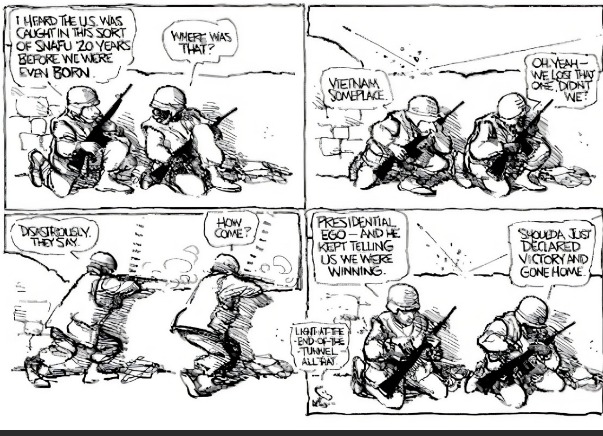
A war in Southeast Asia and rioting in the streets of America. Which needed troops more?


Meanwhile, this candidate had a secret plan to win the war.


The Ho Chi Mihn trail ran a lot more smoothly than the nation's highways.


Back when the South voted Democratic.


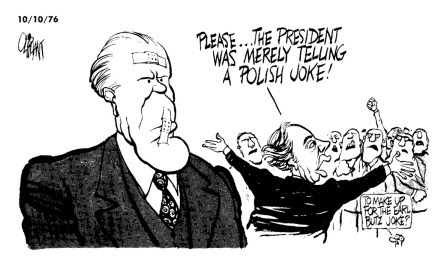
I don't think the Israelis and the Arabs disagreed for this president's benefit, but it did provide a distraction just when he needed one.


"There is no Soviet domination of Eastern Europe and there never will be under a Ford Administration."

--1976 Presidential debate.


And he did.


Just as in Aesop's fable, a virtuous ant (Jimmy Carter) triumphed over a debauched grasshopper (Teddy Kennedy)...


...not that it mattered during the general election.


Strangely enough, I couldn't find an Oliphant Iran-Contra cartoons on the web--and, trust me, folks, he did many of them--but here's at least one half of the equation.


Promises, promises.


Bill Clinton's compartmentalized view of women.


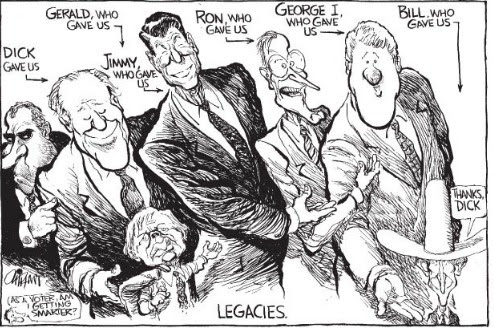
And you thought there was a lot of begetting in the Bible.


Guantanamo Bay wear.


History repeats itself...


...sort of.


The mission wasn't accomplished in New Orleans either.


From 2011. If anything, that fourth branch of government has gotten bigger in the years since.


Before the election...


...and after.


Life, liberty, and the pursuit of happiness.


This is from 2013. They've since found room for dessert.

Now I told you Pat Oliphant retired from cartooning in 2015.


In 2017, he came briefly out of retirement. Perhaps it was the threat to the republic that did it.

And finally, if you have very sharp eyes, you may have noticed a recurring character in these cartoons:


Meet Punk the penguin, Oliphant's alter ego. Just be careful you don't accidentally step on him.


Sunday, July 17, 2022

Fangmate of the Month


I wonder if the late comedienne Phyllis Diller's penchant for wisecracks about her own homely appearance would fly today. Here's one example: "A Peeping Tom was outside my house. He asked me to pull down the shades."  A person of such low self-esteem is in obvious need of a life coach. Is Tony Robbins available? Don't bother. In the middle decades of the last century Diller figured out that the best way to unleash the power within was by subverting the outwardly powers that be. With her electromagnetized hair/wig, ink blot mascara, tubercular laugh, conducting baton-length cigarette holder, and baggy Sunday funny pages-colored minidresses, Diller took the old comic hag stereotype and gave it an updated, consumerist, quasi-countercultural twist that made her one of the more memorable figures of 1960s-and-early 70s comedy and a backdoor American original. If she was self-loathing, then she loathed herself all the way to the bank. Diller was hot enough and hip enough by 1966 that the then-popular girlie magazine Playboy came to her with what must have been a rather surprising offer: a nude photo shoot. That she said yes may have been even more surprising. The whole thing was meant to be a joke, a way for the magazine to show that it could make fun of itself with the help of a woman famous for making fun of herself. Laughter, not titillation, was the goal. Diller, a veteran of the Playboy Club stand-up comedy circuit, seemed to enjoy the opportunity to appear in front of a camera wearing nothing but a Victorian-style bedspread. Unless its Hugh Hefner's beach towel. You decide:

The above photo was never published. Playboy ended up scrapping the whole idea. While a partially nude Phyllis Diller may not have been Jayne Mansfield, neither was she, when it comes to getting laughs, Phyllis Diller. And that Peeping Tom just might have kept right on peeping.


Saturday, July 9, 2022

Erasures


1940-2022

Though he did some interesting work in the 1960s, James Caan's real heyday as an actor was the 1970s. First he played the real-life dying NFL player Brian Piccolo in Brian's Song, the first and easily the best of the disease-of-the-week made-for-TV movies that once gave hypochondriacs plenty of reasons to turn off the tube and pick up a book instead. After that success, it was mostly the big screen, baby (I imagine him talking like that.) I don't know if a passing resemblance to a young Marlon Brando is what got him cast as an older Marlon Brando's hotheaded son Sonny Corleone in The Godfather, but he emerged from it a star. Though his character did not survive the Mafia drama, he nevertheless got a flashback cameo at the very end of The Godfather: Part II. Other notable 70's films include Cinderella Liberty, The Gambler, Funny Lady, Rollerball, Freebie and the Bean, and Chapter Two. After 1981's Thief, there were many, many more misses than hits, but the hits are notable. There's the 1988 buddy-cop science-fiction action film Alien Nation, and in 1990s, Caan is Kathy Bate's best-selling author-prisoner in the enormously successful Stephen King thriller Misery. Though he was best known for tough guy dramas, Caan also had a flair for comedy, and can be seen to good effect in '92's Honeymoon in Vegas and the 2003 Christmas classic Elf. In 2016, the actor voted for Donald Trump, a man who often comes across as a Mad magazine parody of Caan.


1923-2022

Comedian and comic actor Larry Storch was never a huge star if you measure that sort of thing by the number of starring roles in comedy movies and long-running comedy TV shows, but he didn't seem to lack for work, a man whom producers and directors could depend on to be funny even when the script fell far short of that. Storch started out in standup, specializing in dialect comedy and imitations of famous people, such as Cary Grant (according to Grant himself, Storch was the first person to utter "Judy, Judy, Judy!") He was successful enough at doing this to be offered a small part in a movie, then another movie, and another, until he racked up at least 25 of them, along with hundreds of TV guest shots. He also did voice-over work in many cartoons, including Drac on The Groovy Ghoulies. However, the role Storch is best known for is that of Corporal Randolph Agarn for two seasons on the 1960s Wild West parody F Troop. That sitcom's portrayal of Native Americans might not pass muster today, but all I can say is as goofy as the Indians behaved, the palefaces on the series were a lot goofier, and no one was a goofier, or more hilarious, paleface than Storch.


..............................................................................................................................................


CONFIDENTIAL TO BETTE MIDLER:

Cancel The New York Times subscription already.


Sunday, July 3, 2022

Awesome Audio (Freedom of the Press Edition)


The overturn of Roe vs Wade, and the prospect it raises that all the rest of our constitutionally protected rights and liberties are temporary and can be rescinded at a 6-3 Supreme Court moment's notice, has not left me in a very patriotic mood this Fourth of July weekend. However, seeing as I get tomorrow off, I should at least try to get into the spirit of things. To that end I've turned to the man pictured above for some guidance. First generation American (father born in Spain, mother in Bavaria) John Philip Sousa wrote a number of musical compositions that we've come to regard as patriotic standards--as well as mainstays at high school pep rallies and high school football halftime shows across the land. I've chosen one of those immediately recognizable standards for you all to listen to, but before I do, here's what I found out. This melody originally was meant not to glorify America, secondary education, nor a domestic reboot of rugby, but rather...


...a newspaper! In a spirit of journalistic bipartisanship, former Republican Postmaster General Frank Hatton and former Democratic Congressman from Ohio Beriah Wilkins bought the 12-year-old Washington Post in 1889 and needed some way to promote it. So they beseeched Sousa, at the time the conductor of the United States Marine Band (nicknamed "The President's Own") to come up with a march, and he did just that. The composition was immediately popular both here and in Europe, making Sousa a transatlantic celebrity, and earning him the nickname the American March King. Whether all this led to more newspaper subscriptions I can't tell you, except to say there still is a Washington Post, though at this late date you may associate the paper's namesake march more with fireworks and varsity sports than with Woodward and Bernstein. Have a listen: 

Brings you back, huh? All we need now is a cheerleaders' pyramid.


Meh. Try again.


 There, girls, that's more like it!
 

It just so happens that today is the late clarinetist Pete Fountain's birthday. And if that wasn't just so happening enough, it also just so happens that he once put out his own New Orleans Dixieland version of Sousa's venerable tune. Put on your Mardi Gras masks and listen: 


 So which version of "The Washington Post March" is better?


You'll have to ask him.


Saturday, June 25, 2022

Chattel Drive


Now that the Supreme Court has done away with a woman's right to an abortion...


...will these be the next to go? 

Monday, June 20, 2022

Barbary Bonhomie


Actress Olympia Dukakis was born on this day in 1931 (she died just last year, which I criminally let slide by because I was working on something else at the time.) She deservedly won a Best Supporting Actress Oscar for her role as long-suffering Italian-American wife and mother Rose Castorini in 1987's Moonstruck. As good as that movie is--one of the best films of the '80s in my opinion--I'd like to focus on an equally memorable character of hers, middle-aged, free-spirted San Francisco landlady Anna Madrigal, and that beings us to the dude right next to Dukakis, writer Armistead Maupin. Starting in 1974, Maupin took a page out of Charles Dickens and began writing a series of interconnected stories that appeared first in the Marin County-based Pacific Sun, and when that paper folded, the San Francisco Chronicle. Once Maupin had enough material, he did a bit of rewriting, and in 1978 came out with this:

The humorous and sometimes poignant adventures of a collection of straights and gays living in the City by the Bay, it proved to be a best-seller and has been followed by many sequels in the decades since. The television rights to the book was picked up by HBO, with hopes of turning it into a weekly sitcom. But the novel's casual attitude toward casual sex (particularly among gay men) made it seem less like a sure bet as Reaganites took over of the country and the AIDS pandemic began taking its deadly toll. So the rights were dropped, but then quickly picked up by...

...4? The rights were picked up by a number? Actually, it's Channel 4, a British network, and rival of the BBC, that came into existence in 1980. Tales of the City, the miniseries, made its television debut in the United Kingdom in September 1993. Four months later, it crossed the Atlantic, ending up...


...here, a chance if there ever was one for the publicly-funded, nonprofit US network to let its hair down, and get big ratings in the process (though not big enough to calm down outraged conservatives in Congress, who've made sure nothing like that would ever again be shown on a broadcasting system that gets 15% of its operating budget from the federal government, the subsequent reruns and three sequels ending up on cable instead.)

I doubt if too many Americans watching PBS' American Playhouse in 1994 realized they were viewing a British production since the whole thing seemed as American as Ernie and Bert. The following is the trailer for the 20th anniversary DVD box set, but if you were around back in the day, try to imagine seeing it for the first time during the early years of the Clinton administration:

British production notwithstanding, all those American accents would have sounded a bit odd on Masterpiece Theatre, don't you think? Of course, the nudity would have made it odder still.

You saw a few seconds of it during the trailer, but here's the scene in its entirety of the first meeting between Laura Linney's Mary Ann Singleton and Olympus Dukakis' Anna Madrigal:

Mary Ann Singleton is from Cleveland, as am I, and neither one of us can tell you what the hell that...


...Tennyson poem has to do with anything. Maybe if I google it:

How sweet it were, hearing the downward stream,
With half-shut eyes ever to seem
Falling asleep in a half-dream!
To dream and dream, like yonder amber light,
Which will not leave the myrrh-bush on the height;
To hear each other's whisper'd speech;
Eating the Lotos day by day,
To watch the crisping ripples on the beach,
And tender curving lines of creamy spray;
To lend our hearts and spirits wholly
To the influence of mild-minded melancholy;
To muse and brood and live again in memory,
With those old faces of our infancy
Heap'd over with a mound of grass,
Two handfuls of white dust, shut in an urn of brass!

I'm pretty sure lotus is some kind of drug (Anna Madrigal attaches joints to the doors of new tenants as a welcoming gift), but all this stuff about tender curving lines of creamy spray, I just don't get! Maybe if I google some more:


Hmm. It sez here it's a poem about "mariners." 

Now I get it.