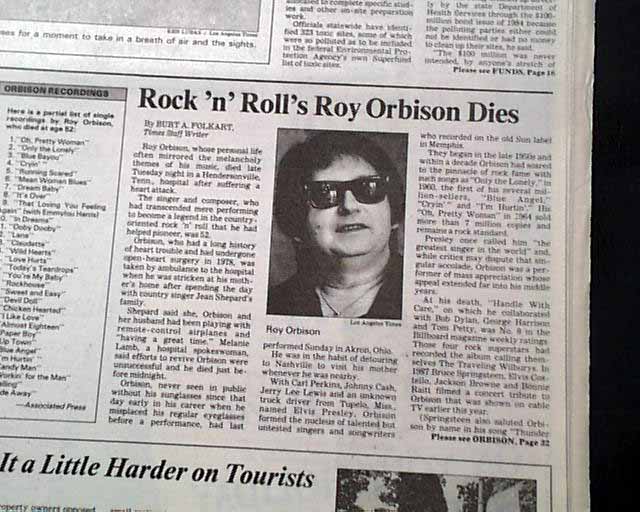
Pop singer Roy Orbison was born on this day in 1936. For someone whose public persona was that of a man of mystery, he was very open to giving interviews, and I had close to a dozen to choose from on YouTube. Here's the one I finally settled on, conducted amidst a 1972 tour of Australia:
The dark glasses. The black hair. The usually black wardrobe. The mournful singing. So much a part of the Orbison mystique. And it's tempting to say that...
...the tragedies to which the Aussie interviewer alluded was the key to the Orbison mystique. Until you find out it all came together before the bad stuff happened. Take the most famous part of the persona, the ebony spectacles. Orbison wasn't blind, but neither was his vision 20/20. According to the performer himself, he had left his regular glasses behind on a plane, and so had to go out onstage with a pair of prescription Wayfarer sunglasses. Afterwards, he decided to make it a regular thing. It hid his stage fright, and, well, it also hid the fact that he wasn't the handsomest man in the world. Orbison's hair, like Elvis Presley's, was brownish-blondish, and, again like Elvis, he died it jet-black so the top of his head wouldn't seem to disappear under the bright lights. The black clothes went with the black hair and black lenses. As for his choice of singing material, much of which he wrote or co-wrote himself, Orbison had grown up in Texas listening to country and western music, much of which was of the somebody-done-somebody-wrong variety. And he heard the blues, which in its rawest form is about experiencing, well, the blues. There's no evidence that he was ever exposed to opera, though his ethereal vocal style earned him the nickname The Caruso of Rock. Whatever the exposure, the voice itself he was born with, and it wasn't tragedy but another word that begins with a T that is the key to Orbison's mystique: talent.
OK, enough with the achy, breaky heart. How about something a little more upbeat?
Listening to the lyrics and watching the grainy images, it occurs to me that by today's standards, this could be a song about a stalker.
Of course, when it comes to stalking, Orbison has nothing on this guy.
The 1980s saw a revival of interest in Roy Orbison. He was even in a supergroup.
Orbison and Bruce Springsteen. Two generations of rockers. Looking at this picture it's tempting to say a torch is being passed. But not so fast...
December 1988. Just 52 years old. That's 11 years younger than Sammy Davis Jr (died 1990), 17 years younger than Tennessee Ernie Ford (died 1991), 17 years younger than Burl Ives (died 1995), 17 years younger than Howard Keel (died 2004), 17 years younger than Pete Seeger (died 2014), 18 years younger than Leonard Bernstein (died 1992), 19 years younger than Dean Martin (died 1995), 19 years younger than Robert Merrill (died 2004), 21 years younger than Frank Sinatra (died 1998), 28 years younger than Lionel Hampton (died 2002), 29 years younger than Cab Calloway (died 1994), 29 years younger than Gene Autry (died 1998), 33 years younger than Roy Acuff (died 1992), 33 years younger than Lawrence Welk (died 1992), and 48 years younger than Irving Berlin (died 1989.) That's NOT how you pass a torch!
However, as another rock star or cartoon bear or baseball player or somebody once said, it ain't over 'til it's over. Orbison had just completed a new album, Mystery Girl, a few weeks before his death. A song from that album, "You Got It", co-written with fellow Traveling Wilburys Tom Petty and Jeff Lynne, rose to No. 9 in the US and No.3 in the UK. Here's the video:
Roy Orbison's personal losses were enormous. In the public sphere at least, he was able to give more freely. And he did
It's probably in bad taste to refer to a death as a scheduling conflict, but it so happens that actor Robert Morse died right when I was putting the finishing touches on this post. I always liked him in whatever I saw him in, and even if his fame was at best relative, I wasn't about to pass up his passing. His career was mostly on Broadway, but one of those Broadway productions, How to Succeed in Business WithoutReally Trying, was also a 1967 Hollywood movie, and the character of window washer-turned-chairman of the board J. Pierrepont Finch was for many years Morse's best-known role. As for Hollywood movies based on something other than Broadway productions, Morse had large parts in two minor classics of the 1960s, The Loved One, a satire of the cemetery business (both two-legged and four-legged), and the cameo-laden A Guide for the Married Man, in which he schools Walter Matthau on the fine art of adultery. In recent years, Morse became well-known all over again for playing senior advertising executive Bertrum Cooper in the highly regarded cable series Mad Men. Those of you who think I've seen every TV show ever made may be surprised to learn that I've never watched a single episode of MadMen, but I have no problem believing Robert Morse was very good in it.
I have always felt comedy and tragedy are roommates. If you look up comedy and tragedy, you will find a very old picture of two masks. One mask is tragedy. It looks like it's crying. The other mask is comedy. It looks like it's laughing. Nowadays, we would say, "How tasteless and insensitive. A comedy mask is laughing at a tragedy mask."
Actress Louise Lasser was born on this day in 1939. She's best known for playing the pigtailed, Mary Quantesque-attired, neurotic-but-childlike working-class housewife title character on...
...this show, producer Norman Lear's black comedy soap opera masterpiece, which ran for two uproarious seasons in the mid-1970s. As if All in the Family, Sanford and Son, Maude, Good Times, and The Jeffersons weren't enough of an assault on Daughters of the American Revolution sensibilities, Lear and his writers satirically took on Red State homogeneity a half a century before the term Red State was even coined and on a consumer culture masquerading as the American Dream. But don't take my word for it. Louise Lasser discusses her unhinged TV alter ego in this recent interview:
Not surprisingly, given the passage of time, she looks a lot different. But the toothy grin is still there, and when she talks about the show, I find myself...
...transported back in time.
Mary Hartman, Mary Hartman had a lot of famous and/or outrageous set pieces, from the man drowning in chicken soup to the aspiring country singer totally ruining her career by cheefully referring to Jews as Christ-killers on Dinah Shore's talk show to Mary having a nervous breakdown on David Susskind's talk show to the boy preacher electrocuted in a bathtub by a wayward television set to the wife beater who ends up impaled on an artificial Christmas tree and whose feet show up where the head should be at an open casket funeral. Unfortunately, I can't show you any of those set pieces because they're only available on YouTube in full half-hour episodes. What I can do is provide little snippets that should give some idea of MHMH's low-key out-of-key humor.
Fernwood, Ohio was entirely fictional, and these places are, or in some cases were, entirely nonfictional, yet I like to think Mary, Fernwood's most prominent citizen, spent much of her time away from home in such venues, and wherever else consumer goods could be purchased. Mary may have been unsure about a lot of things, but the reliability of household products advertised on TV wasn't one of them:
Linoleum--attention must be paid!
The Anti-Mary Hartman.
Friends and family. See that older man on the far right? Why doesn't he take off that overcoat?
Forget I asked.
Not that it excuses the old fart's behavior...
...but there was a sexual revolution going on at the time:
Maybe one of them should put on an overcoat. Maybe both of them should put on an overcoat.
We do know that Tom and Mary had sex at least once:
My earliest memory of the word "cramps" had to do with a warning by my mother not to go into the water less than a half hour after eating. Later on, I found out it could also mean something of a more intimate nature. In the comment section of the YouTube page where I snagged the above video, the following exchange occurred:
I read this article on an eBay page, where I was able to "zoom" in. Unfortunately, I can't replicate that zoom, but basically, it's Bobby Rydell hedging his bets. The conventional wisdom ever since 1956 was that rock'n'roll couldn't last, that it was a passing fad. Well, in 1960, when according to that eBay site, this article appeared somewhere (it's torn out of a magazine, and that's what's for sale), the fad wasn't so passe that Rydell couldn't have a song go all the way to number two on the Billboard chart. That was in addition to several other hits that year. Rydell got his first hit on the charts a year earlier, and would continue to have hits for the next couple of years.
Finally, in 1964, rock 'n' roll ended...
...and rock began.
At least that's how they tell the story nowadays. It may be that there's no actual cut-off date between "rock 'n' roll" and "rock", but I do know the language had changed for good by the time I got to seventh grade some ten years later and told this one classmate I liked rock 'n' roll, only to be dismissed as a total nerd. Didn't I know rock was Led Zeppelin and rock 'n' roll was something they played on Happy Days? The Beatles, at least, liked rock 'n' roll, which had come along when they were entering their teenage years, and was what inspired them to go into music in the first place. But their tweaking of the sound (along with further tweaking by the Rolling Stones, Bob Dylan, Jimi Hendrix, and several others) spelled doom, or the nostalgic circuit, for the likes of Bobby Rydell. But he never complained. And it's not like he sunk into total obscurity. In fact, he got a...
...high school named after him.
(My apologies to Shady, who recently showed this on his own blog.)
Harold Nicholas was born on this day in 1921 (he died in 2000.)
Harold's older brother Fayard (1914-2006)
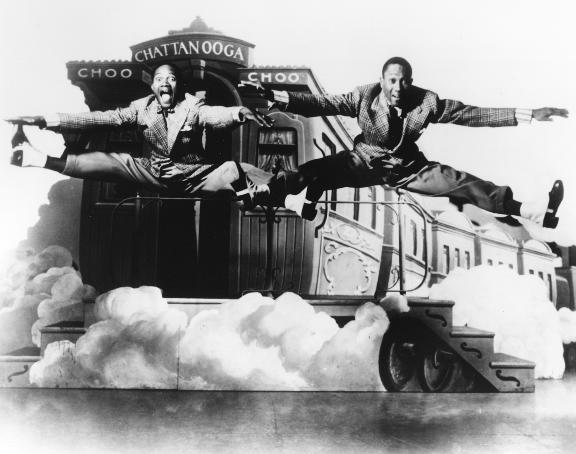
Here's the two of them together, but the above photo is a bit misleading, as the Nicholas Brothers were rarely seen...
...sitting still.
I briefly wondered if I should do this post as an "Under the Radar", my recurring feature dedicated to talented people who never quite achieved fame, but the above advertisement convinced me that the Nicholas Brothers were famous enough, at least in their day. Touring the continent--that would be Europe--triumphant appearances in England, France, Sweden, Portugal, Italy and Denmark. Unfortunately, here in North America, the continent of their birth, there were no triumphant appearances in the United States South, either live or on film. On the latter score, their motion pictures either were all-black productions (and often shorts) which never made it past the Mason-Dixon line, or mostly white pictures that featured the two of them in specialty numbers (one of which they shared with a pre-Carmen Jones Dorothy Dandridge, Harold's then-wife) that existed outside a movie's main storyline, so as to be easily edited out when it was shown in the land of Dixie. But such scenes weren't edited from the films shown in London, where Harold and Fayard became popular enough to warrant a Royal Command Performance in 1948. What did King George VI care about Jim Crow?
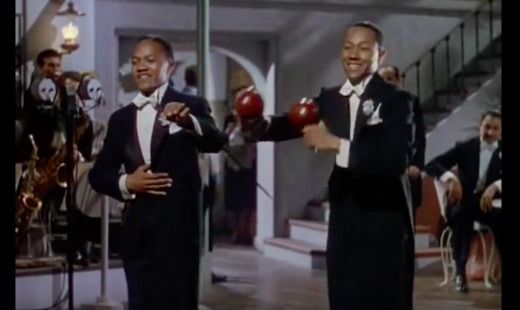
Produced by Jack Haley Jr (the Tin Man's boy), 1985's That'sDancing! was an offshoot of Haley's That's Entertainment! film compilations. Starting in 1974, these were themselves theatrical films that celebrated the heyday of the Hollywood musical. What made TD! a bit different from TE!, is the latter was solely dedicated to Metro-Goldwyn-Mayer, which could give someone too young to enjoy that heyday the misleading impression that only MGM made musicals in the 1930s, '40s, and '50s. In fact, all the major Hollywood studios produced musicals. It was a very popular form of movie entertainment in that era. Now at the time Metro did have deeper pockets than the other studios, and eventually was able to lure stars of the genre who had originally achieved success elsewhere. For instance, Fred Astaire first rose to fame at RKO before hearing the roar of Leo the Lion. Astaire eventually danced through enough of MGM's Metrocolor product to be featured quite prominently in all three That's Entertainment! movies, but was never seen dancing with Ginger Rogers in black-and-white. That's Dancing! redresses this imbalance by showing production numbers from all the major studios, thus giving you a more rounded picture of motion picture history (part of MGM's generosity in that regard may have had something to do with then-owner Ted Turner also owning the film libraries of several of its competitors, but I'm just speculating.) The Nicholas Brothers did do one film for Metro, The Pirate, but most of their cinematic movements were at 20th Century Fox (which I guess qualifies them these days as Disney Legends), including Down Argentina Way, which is featured in That's Dancing! Because it's a bit similar to another clip I want to show you, I'm going to skip DAW for now, but I will show you Harold and Fayard, now in their golden years, promoting the release of That's Dancing! Watch:
They seem like a couple of nice guys.
And they were a couple of nice kids. Their mother was a pianist and father a drummer who played in their own band at Philadelphia's Standard Theatre, which from 1914 to 1931 specialized in black vaudeville entertainment. Oldest boy Fayard got to see all the top black entertainers at his parents' place of employment and obviously was quite taken with the dancers. Entirely self-trained, he taught his sister Dorothy and kid brother Harold how to dance, and they formed their own act, The Nicholas Kids. Dorothy soon dropped out and that was when the act's name was changed to The Nicholas Brothers (of course they were that before there ever was an act.) Their combination of tap and acrobatics got them noticed pretty quickly, playing not just the Standard but now-legendary Cotton Club (though at the latter only white audiences were allowed to see them perform, discrimination at its most head-scratching.) Then came Broadway. The Ziegfeld Folliesof 1936 (a show that also featured Bob Hope and Josephine Baker), and the very next year Rodgers and Hart's Babes in Arms. All well and good, but none of that meant posterity. For that you needed moving pictures, especially for those two, who, after all, moved pretty damn fast, examples of which now follow.
First up is a scene from an all-black movie about an all-black radio station none-too-subtly titled TheBlack Network. Fayard is 21 (but looks 15) and Harold is 15 (but looks 10.) Watch:
As you watched them dance, did you keep in mind that it's supposed to be a radio audition? At least it was tap and not ballet.
Finally, we jump ahead seven years to 1943, by which time both brothers were old enough to drink, not that it matters since they couldn't possibly have done what you're about to see next unless they were cold sober. Deciding to do it in the first place, then they might have been as high as a Sun Valley chairlift. Here's the preternaturally amazing Nicholas Brothers at their amplified-tapping, gravity-defying, land speed record-breaking, bone fracture-resistant best. But first you have to sit through a few minutes of Cab Calloway (and that, my friends, is hardly a hellish experience):
And to think, spandex hadn't even been invented yet!






.jpg)